


In animals, low intestinal microbiota diversity is often associated with deleterious symptoms. In an article published in Communications Biology, scientists from Aix Marseille Université and CNRS use mathematical modelling to reveal how a renewed supply of microbes through the diet can help maintain high diversity, and therefore better health. This discovery has led to a better understanding of the importance of the microbial component of the diet, and the possibility of optimizing probiotic treatments.
Reading time: 3 minutes
Microbes in the diet to maintain diversity
In the digestive tract, a multitude of microbes participate in biochemical processes fundamental to host physiology. The composition of this microbial community depends on many factors, including diet. But food doesn't just contain nutrients! It also contains living micro-organisms.
Some of these reach the intestines, where they can interact with the resident intestinal flora and alter its balance. This raises an important question: can microbial intake be optimized to promote a healthy intestinal microbiota for the host?
Determining the optimal dose
The composition of the intestinal microbial community is dynamic. The microbes present may multiply, while others may die out under the action of the immune system or as a result of competition with other microbes. It is also influenced by an incoming flow (ingested microbes that have survived the acidity of the stomach) and an outgoing flow (eliminated in the stool).
To model these phenomena, scientists use a system of coupled dynamic equations, parameterized with data from the scientific literature. Based on these equations, the scientists determine the expected average diversity as a function of the various dynamic parameters (birth, competition, death, inflow and outflow) and dietary characteristics (numbers of microbes ingested and microbial composition).
This work, published in the journal Communications Biology, reveals several important findings:
- It doesn't matter when you consume the microbes: taking them all at once or several times during the day amounts to the same thing.
- As soon as the number of microbe types in the system exceeds twenty, there is almost always a feeding strategy that maximizes the diversity of the host community.
- When the number of microbe types becomes very large, the maximum diversity achieved in the host corresponds to that of the diet, and the quantity of microbes ingested approaches the quantity of those eliminated.
A first step towards personalized microbiota medicine
These results are robust to several model variants, and the orders of magnitude found are consistent for small, simple animals such as the Drosophila fly or the C. elegans worm. For applicability to humans, extensions of the model will need to be considered, to take into account more complex interactions between microbes and host. This research represents a first step towards the control of intestinal microbiota through diet, for therapeutic purposes.
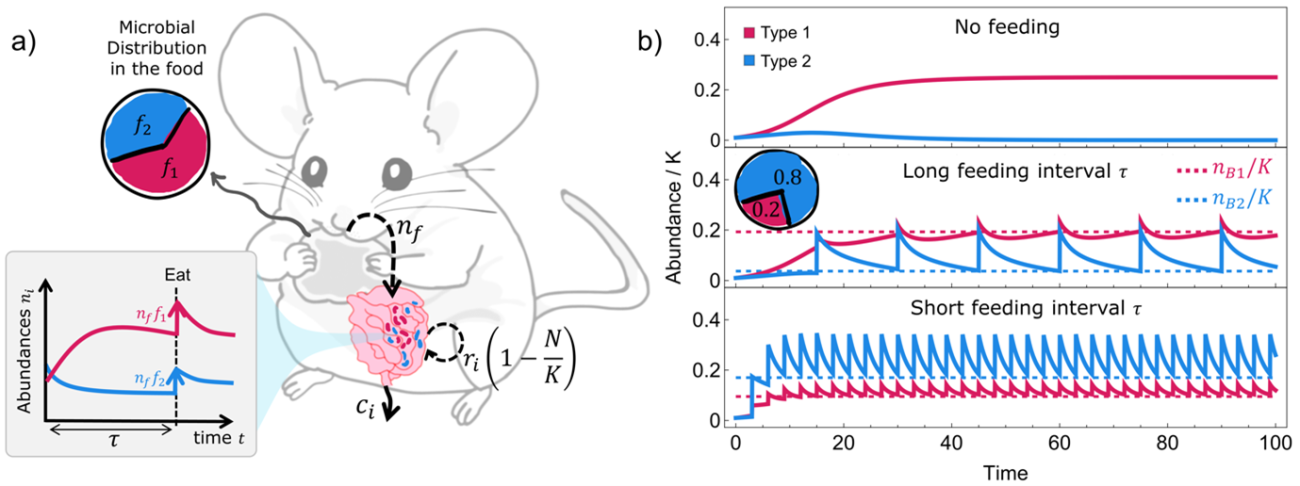
Ingesting microbes through the diet helps maintain the diversity of the intestinal microbiota. On the left, schematic diagram of the mathematical model, with a mouse as an example host: for ease of visualization, only two types of microbes are shown. They are ingested in a certain proportion at fixed intervals. In the intestine, they undergo multiplication, death and elimination processes. On the right, temporal dynamics of microbe numbers: without microbes in the diet, type 2 is lost. Feeding prevents its extinction and maintains diversity at a high level.
Contact à ajouter
References :
Marquioni, V.M., Hofacker, AC., Villavicencio, J.V. et al. Modulating microbial intake helps to maintain the gut microbiome diversity. Commun Biol 9, 533 (2026). https://doi.org/10.1038/s42003-026-09867-6
Article published May 6, 2026.
Discover also


Share on social media or