


The DESI (Dark Energy Spectroscopic Instrument) spectroscopic survey, which began in May 2021 and will run for six years, has observed more than 7.5 million galaxies after just seven months. It breaks all records, creating the largest and most detailed map of the universe ever made.
Reading time: 2 minutes
Studying dark matter and energy
DESI, installed at the focus of the Mayall telescope at Kitt Peak Observatory in Arizona, is dedicated to the study of dark matter and energy. It will catalog more than 35 million galaxies, fuelling a huge variety of research in cosmology and astrophysics.
A catalog of over 35 million galaxies
Opposite are 2D slices of the 3D galaxy map from DESI's first months in operation. The Earth is at the center, with the most distant galaxies over 10 billion light-years away. Each dot represents a galaxy. These slices show only around 800,000 of the 7.5 million galaxies currently acquired, representing only a fraction of the 35 million galaxies that will appear on the final map.
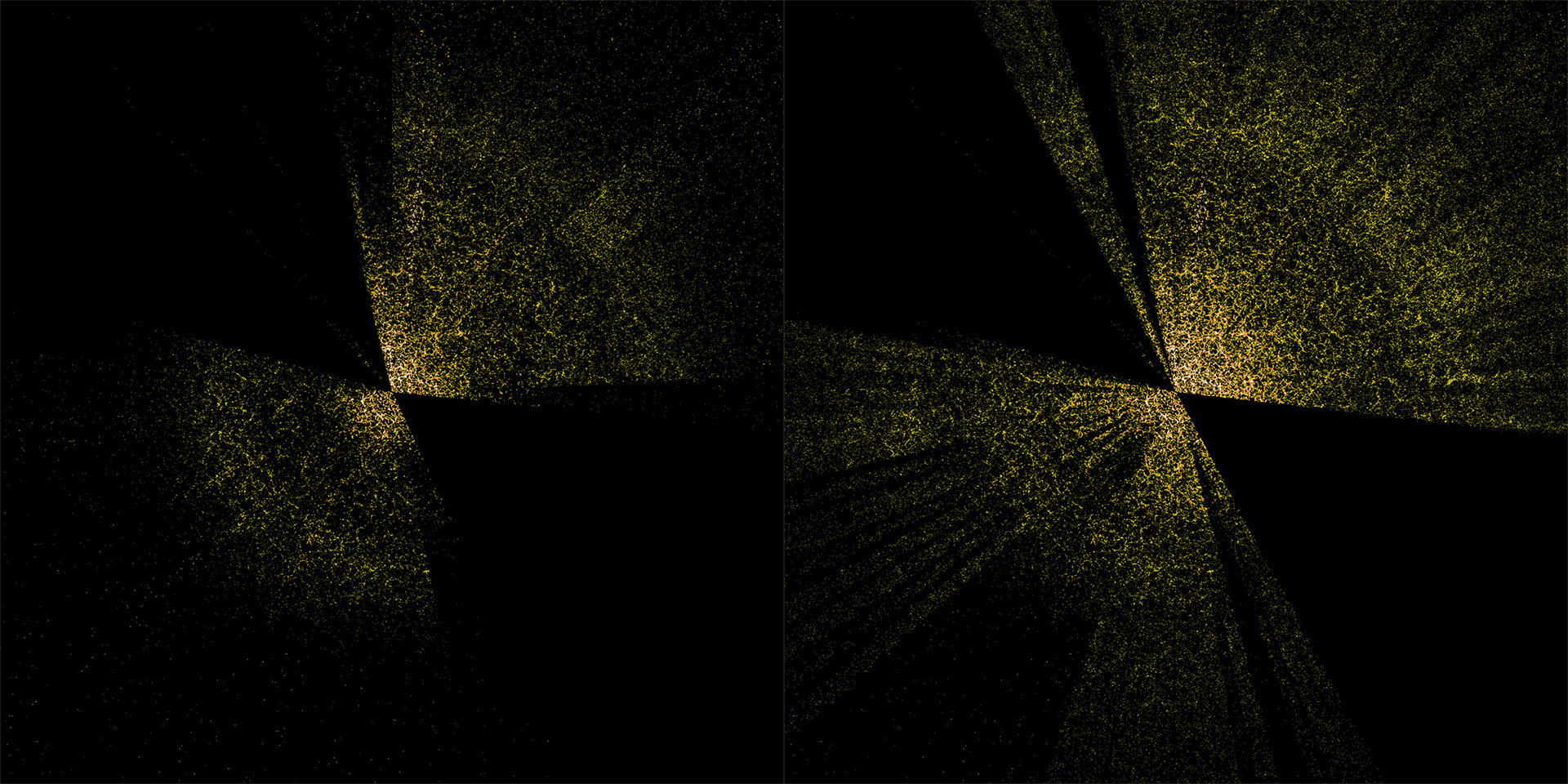
Representation in yellow on a black background of the 2D slices of the 3D map of galaxies from the first months of DESI use - Credit: D. Schlegel/Berkeley Lab
The Observatoire de Haute Provence (OHP), the Centre de Physique des Particules de Marseille (CPPM, AMU/CNRS) and the Laboratoire d'Astrophysique de Marseille (LAM, AMU/CNRS) are taking part in DESI thanks to initial support from the A*Midex university foundation and Labex OCEVU, as well as the Institut d'établissement Physique de l'Univers (IPhU).
Article originally published in the March 2022 Lettre d'AMU.
Discover also


Share on social media or