


A research team from CNRS and Aix-Marseille Université has demonstrated that members of a baboon group can establish social conventions among themselves. In this case, they all agree on how to solve a problem in order to obtain a reward more quickly. This is the first time that such conventions have been studied experimentally in an animal species.
Reading time: 3 minutes
First discovery of social conventions in other primates
Kissing, shaking hands or bowing can be three ways of saying hello or goodbye. This is a social convention: known to all individuals in a group, it enables us to address our greetings quickly. In this way, conventions facilitate the resolution of coordination "problems" frequently encountered by the group, by providing effective, time-stable and arbitrary solutions.
But the principle of conventions is not unique to the human species, as demonstrated for the first time by the results of an experiment conducted at the CNRS Rousset Primatology Station by researchers from the Laboratoire de psychologie cognitive (CNRS/Aix-Marseille Université). Confronted with a device requiring the coordination of two individuals, Guinea baboons established rules common to the whole group in around three days.
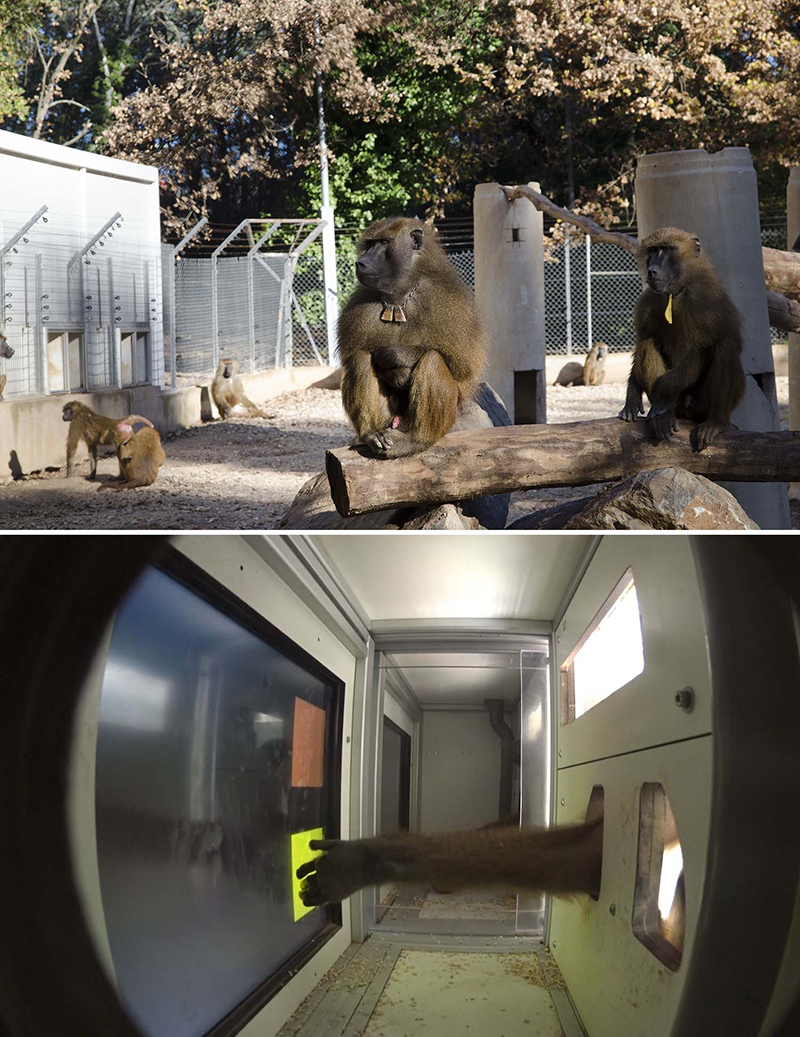
Guinea baboons from the CNRS Rousset primatology station
Guinea baboons at the CNRS Rousset primatology station. The experimental set-up (bottom photo) is located in the building in the background, and the monkeys can access it whenever they like.
Agreeing on the solution
The task proposed to the baboons was as follows: two different images were randomly selected from a set of images and presented via screens to two monkeys. If they wanted to be rewarded, the baboons had to choose the same image. So there wasn't just one possible answer to the experiment, but several. The individuals had to decide among themselves which solution to the problem they wanted, by agreeing on the choices to be made.
The monkeys quickly developed a hierarchical organization of the images: for example, they agreed on the choice of the pink square when it was presented with a light blue square, while they chose the yellow square opposite a pink or light blue square. When the two monkeys could no longer see each other, the group's overall performance was virtually unaffected. This suggests that the baboons were not simply using an imitative strategy to solve this problem, but had coordinated their choices.
These conventions between baboons are stable over time, effective and arbitrary, given that the choice of images was not imposed. They therefore respect the three characteristics of human social conventions. Scientists are calling for new ways of observing groups of non-human primates in the wild to detect such conventions.
Contact à ajouter
Contact à ajouter
Published December 13, 2021 in Philosophical Transactions of the Royal Society B.
Reference: The experimental emergence of convention in a non-human primate. Anthony Formaux, Dany Paleressompoulle, Joël Fagot and Nicolas Claidière. Philosophical Transactions of the Royal Society B, December 13, 2021
Discover also


Share on social media or