


An interdisciplinary team of scientists, including researchers from the Centre de Recherche et d'Enseignement en Géosciences de l'Environnement and the Centre Camille Jullian, have analyzed the carbonates present in the ballast of an ancient ship to identify its construction site.
Reading time: 4 minutes
|
Key facts to remember:
|
The ancient shipwreck Ilovik-Paržine-1
In 2016, around 500 meters off the coast of the small Croatian island of Ilovik, located in the Adriatic Sea, the wreck of an ancient ship, named "Ilovik-Paržine-1", was discovered. Between 2018 and 2022, underwater archaeologists from the Croatian Conservation Institute in Zagreb and the Centre Camille Jullian (Adriboats program) studied the vessel and determined that it was originally around 21.5 meters long and 6.5 meters wide, and that it carried wood and wine amphorae. Using radiocarbon dating and typological analysis of the ceramics, the archaeologists established that the shipwreck occurred between 170 and 130/120 BC.
Ballast made of rocks from the Brindisi region
A ship's ballast corresponds to the heavy material (often stones or sand) placed in the bottom of a ship or attached to its keel to ensure its stability. Researchers at CEREGE have analyzed the carbonate rocks in the ballast found on the wrecked ancient Roman ship. It revealed that the rocks most probably originated from the Brindisi region, located in the Apulia region of Italy. This discovery led scientists to speculate that the ship had been built in a shipyard in or near this ancient city.
In 2021, archaeologists extracted a total of 854 rocks, ranging in diameter from 1 to 40 centimetres, some of which were subjected to sedimentological, petrographic, micropalaeontological and geochemical analyses (carbon, oxygen, and strontium isotopic composition of carbonates). The results showed that almost all the ballast consists of quartz calcarenites of Upper Pleistocene age, deposited in a coastal marine environment. A field mission to analyze Pleistocene marine formations on the Adriatic and Ionian coasts of Italy enabled direct comparison with the ballast rocks.
Homogeneous ballast
The high degree of homogeneity of the ballast elements suggests that this was probably a permanent ballast, loaded during the ship's construction at a shipyard in Brindisi or a nearby port. A second hypothesis would be to consider Brindisi, or a nearby port, as the ship's permanent home port, so that the volume of ballast was always adjusted from a single source of stone. The location of the shipwrecked vessel indicates that it was surely heading north, and that the final destination of its voyage may have been one of the cities located in the northern Adriatic, such as Aquileia, an ancient Roman colony founded around 181 BC and of great commercial and strategic importance.
This study is the result of a collaboration between CEREGE, the Centre Camille Jullian, the University of Lyon, the University of Ferrara and the Croatian Conservation Institute. The results have been published in Journal of Archaeological Science: Reports.
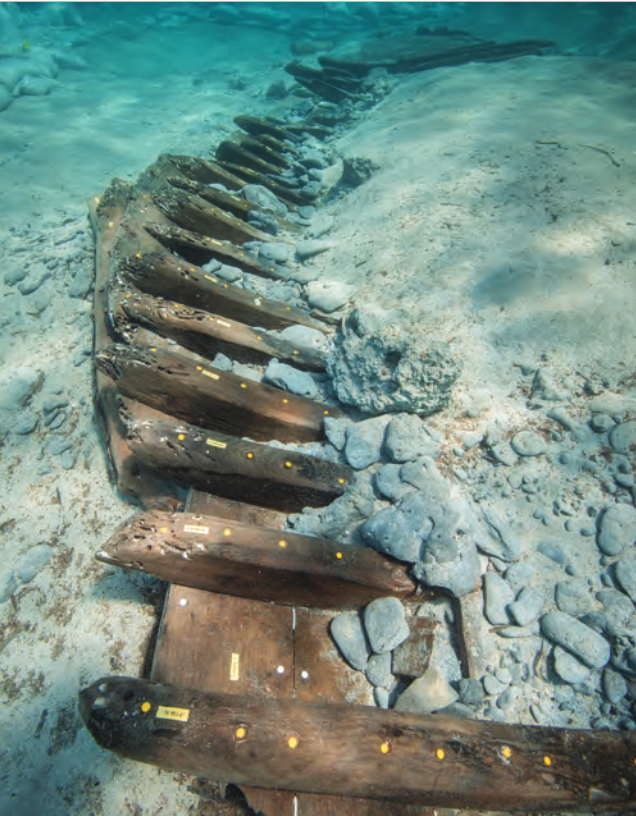
Photo of the ballast found on the wrecked ancient Roman ship "Ilovik-Paržine-1", recovered in 2016 off the Croatian coast.
Contact à ajouter
Contact à ajouter
Contact à ajouter
Informations complémentaires
Article published on July 4, 2024. Read the original publication on the CEREGE website.
Reference : Fournier, F., Léonide, P., Marié, L., Quillevéré, F., Margerel, J.-P., Miholjek, I., Dugonjič, P., Carre, M.-B., Cavassa, L., Morsilli, M., Boetto, G., 2024. Provenance of the ballast stones from the Roman Republican ship Ilovik-Paržine 1: A hypothesis about its place of construction. Journal of Archaeological Science: Reports 57, 104580.
Header photo: © L. Damelet, CCJ-CNRS
Discover also


Share on social media or