


An international team led by Pierre Vernazza, CNRS researcher at the Laboratoire d'Astrophysique de Marseille (amU/CNRS/CNES) and member of the Origins Institute, has demonstrated that 70% of all meteorite falls originate from just three young asteroid families. The team also revealed the sources of other types of meteorite: with this study, the origin of over 90% of meteorites has now been identified.
Reading time: 4 minutes
|
Key facts to remember:
|
An international team of researchers has shown that 70% of all known meteorite falls originate from three young asteroid families (Karin, Koronis and Massalia) formed by collisions in the main asteroid belt 5.8, 7.5 and about 40 million years ago. In particular, the Massalia family has been identified as the source of 37% of known meteorites.
While more than 70,000 meteorites are known, only 6% were clearly identified by their composition (achondrites) as coming from the Moon, Mars, or Vesta, one of the largest asteroids in the main belt. The source of the other 94% of meteorites, the majority of which are ordinary chondrites*, remained unidentified.
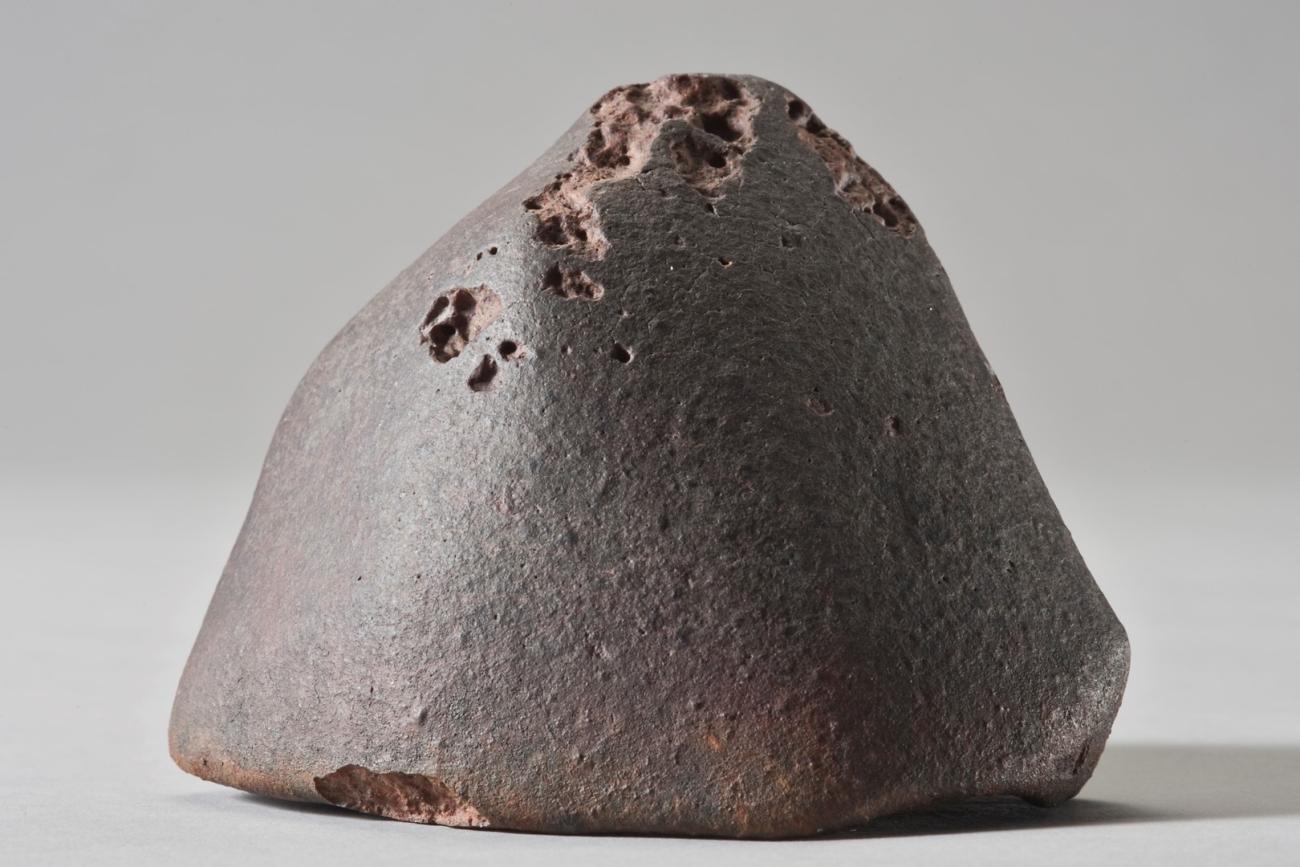
Meteorite El Médano 128, ordinary chondrite (group L), found in the Atacama Desert in 2011 by a team of researchers from the Centre de recherche et d'enseignement des géosciences de l'environnement (Aix-Marseille Université/CNRS/INRAE/IRD). Jérôme Gattacceca, CNRS, CEREGE
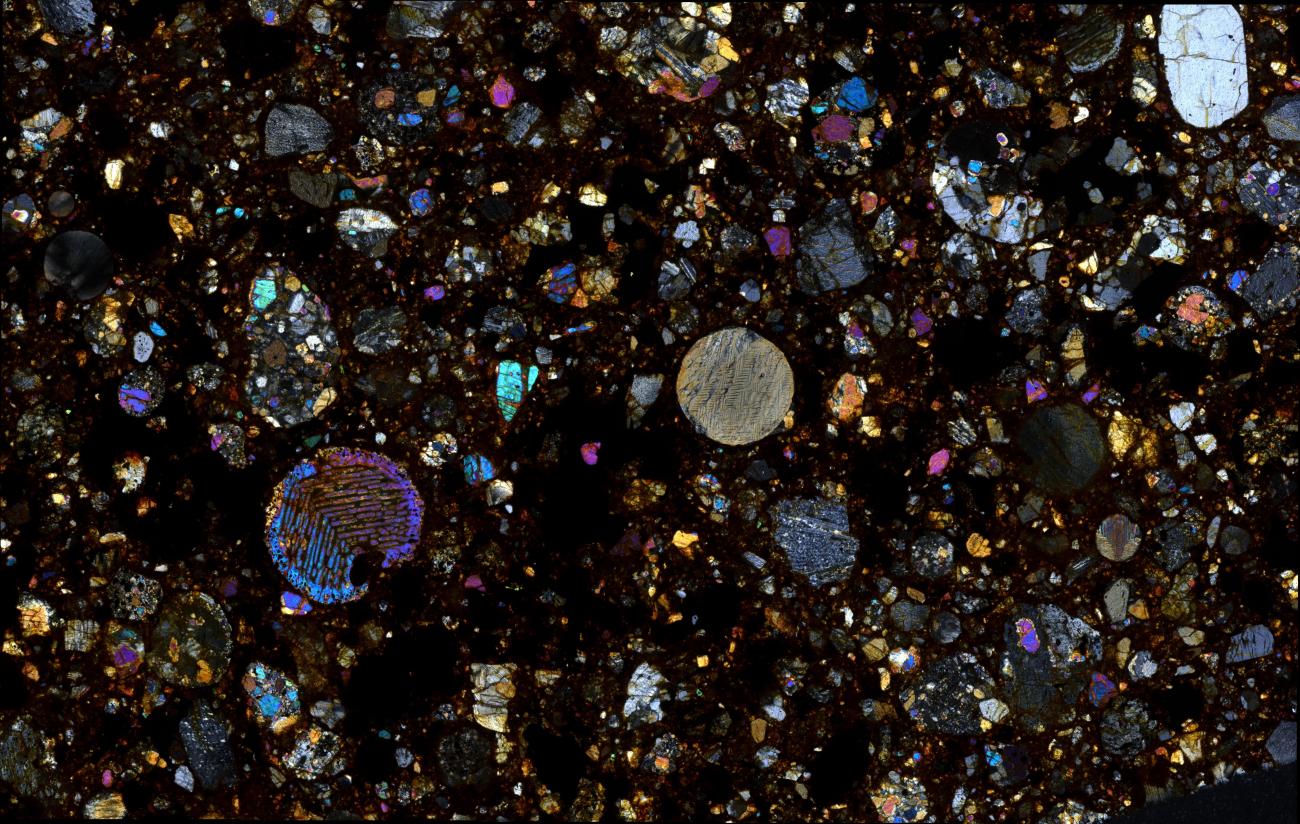
Polarized transmitted-light image of the ordinary chondrite (H group) San Juan 029, found in the Atacama Desert in 2008 by a team of CEREGE researchers. Image width 3 mm. Jérôme Gattacceca, CNRS, CEREGE
Why are these three young families the source of so many meteorites?
This can be explained by the life cycle of asteroid families. Young families are characterised by an abundance of small fragments left over from collisions. This abundance increases the risk of collisions between fragments and, coupled with their high mobility, their escape from the belt, possibly in the direction of Earth. The asteroid families produced by older collisions, on the other hand, are "depleted" sources of meteorites. The abundance of small fragments that once made them up has naturally eroded and finally disappeared after tens of millions of years of successive collisions and their dynamic evolution. Thus, Karin, Koronis and Massalia will inevitably coexist with new sources of meteorites from more recent collisions and eventually give way to them.
A method for tracing the family tree of meteorites and asteroids
This historic discovery was made possible by a telescopic survey of the composition of all the major asteroid families in the main belt, combined with state-of-the-art computer simulations of the collisional and dynamical evolution of these major families. This approach has been extended to all meteorite families, revealing the primary sources of the carbonaceous chondrites and achondrites, which come in addition to those from the Moon, Mars, and Vesta.
Thanks to this research, the origin of more than 90% of meteorites has now been identified. It has also enabled scientists to trace the origin of kilometre-sized asteroids (a size that threatens life on Earth). These objects are the focus of many space missions (NEAR Shoemaker, Hayabusa1, Chang'E 2, Hayabusa2, OSIRIS-Rex, DART, Hera, etc.). In particular, it appears that the asteroids Ryugu and Bennu, recently sampled by the Hayabusa2 (Japanese Aerospace Exploration Agency JAXA) and OSIRIS-REx (NASA) missions and studied in laboratories around the world, particularly in France, are derived from the same parent asteroid as the Polana family.
The origin of the remaining 10 per cent of known meteorites is still unknown. To remedy this, the team plans to continue their research, this time focusing on characterising all young families that were formed less than 50 million years ago.
This discovery is detailed in three studies, the first published on September 13, 2024 in the journal Astronomy and Astrophysics (available in open access) and two new ones published on October 16, 2024 in Nature.
Contact à ajouter
Informations complémentaires
The Institut Origines, de la formation des planètes à l'émergence de la vie (Origins, from planet formation to the emergence of life ) is one of the 20 institutes of Aix Marseille Université. The research topic addressed in this article is at the heart of the institute's research. The small bodies from which these meteorites originated formed the building blocks from which today's planets were formed. They therefore participated in the chain of reactions that led to the appearance of life. Find out more about the Origins Institute.
*Ordinary chondrites: Meteorites composed of silicates, they make up around 80% of all recorded meteorites.
Article published October 17, 2024.
Bibliography:
Source regions of carbonaceous meteorites and NEOs. M. Brož, P. Vernazza, M. Marsset et al. Astronomy and Astrophysics, September 13, 2024.
Young asteroid families as the primary source of meteorites. M. Brož, P. Vernazza, M. Marsset et al. Nature, October 16, 2024.
The Massalia asteroid family as the origin of ordinary L chondrites. M. Marsset, P. Vernazza, M. Brož et al. Nature, 16 October 2024.
Discover also


Share on social media or