


In a special issue published on January 6, 2025 in the journal PNAS, researchers from around the world detail the many scientific arguments in favor of returning Martian samples to Earth. Among them, a researcher from the Centre de Recherche et d'Enseignement des Géosciences de l'Environnement (CEREGE, CNRS/AMU/IRD/INRAE/Coll. France) and member of the Origins Institute, stresses the importance of studying the magnetic properties of these precious Martian rocks in the laboratory.
Reading time: 4 minutes
|
Key facts:
|
A call from the scientific community for the return of Martian samples
As we speak, NASA's Perseverance rover is about to carry out its 28th drilling at the surface of Mars. Over the past 4 years, this unique “scientific Swiss army knife” has already covered more than 30 km and collected 27 pen-sized cylinders of Martian rock. Once a total of about 40 samples will collected, they will be delivered to a rendezvous point by the rover. Next, a gargantuan mission called Mars Sample Return (MSR), led by NASA with ESA participation, aims to bring the samples back to Earth.
Because of the extreme difficulty of recovering the drilled samples on Mars, as well as ensuring the strictest quarantine conditions once on Earth, the estimated budget for MSR now exceeds $10 billion. All the more reasons for decision-makers in the nations involved in the mission to take a dim view. To encourage space agencies and decision-makers to continue funding MSR, researchers from around the world have joined forces to detail the many scientific arguments in favor of the mission in a special issue of PNAS. They lay down the fundamental questions that can only be answered by laboratory analysis, with the ultimate question of the past habitability of the Red Planet at the forefront. Among the disciplines represented, paleomagnetism emerges as a key tool for understanding the evolution of Mars' interior, surface and atmosphere.
The magnetism of Martian rocks
Mars is a magnetic planet. The Martian crust is magnetized as a result of the existence of a magnetic field generated in its core around 4 billion years ago, when the surface was possibly habitable. The evolution and extinction of this so-called "dynamo field" could have played a central role in the evolution of Mars' early atmosphere. An important hypothesis is that a thick Martian atmosphere disappeared after the decline of the dynamo field, triggering the transition from a warm and wet planet to today’s cold and dry world.
To test this fundamental hypothesis and shed light on the causes of the loss of Mars' atmosphere, the nature and history of the dynamo field and crustal magnetization must be better understood than they are today. This can only be achieved through the analysis of well-preserved, oriented ancient samples, with a geological context available for laboratory study.
Some minerals contained in terrestrial and extraterrestrial rocks have the incredible ability to preserve a record (called magnetization) of the magnetic fields to which they were exposed. The disciplines of rock magnetism and paleomagnetism enable us to characterize these minerals, the period during which the magnetization was acquired, and the intensity and orientation of the magnetic field that gave rise to it. For example, the paleomagnetic study of the Martian meteorite ALH 84001 has led to the realization that Mars probably generated a dynamo field 4 billion years ago. Unfortunately, meteorites of the age of ALH 84001 are rare, and those still carrying such an ancient magnetization are virtually non-existent, because of magnetic contamination.
Magnetic measurements conducted on MSR samples should enable us to reconstruct the intensity and geometry of the Martian dynamo field over time, and roughly date its extinction. By correlating these data with mineralogical, chemical and isotopic indicators, it would be possible to understand the impact (or absence of impact!) of the dynamo's extinction on the evolution of Mars' surface and atmosphere, and therefore on the evolution of the planet's habitability conditions. These magnetic measurements could also constrain other key processes in Martian evolution, including how the field was generated, the possibility that plate tectonics existed, the mineralogy of the crust, how water and lava flowed to the surface, and even whether the samples preserved any fossils.
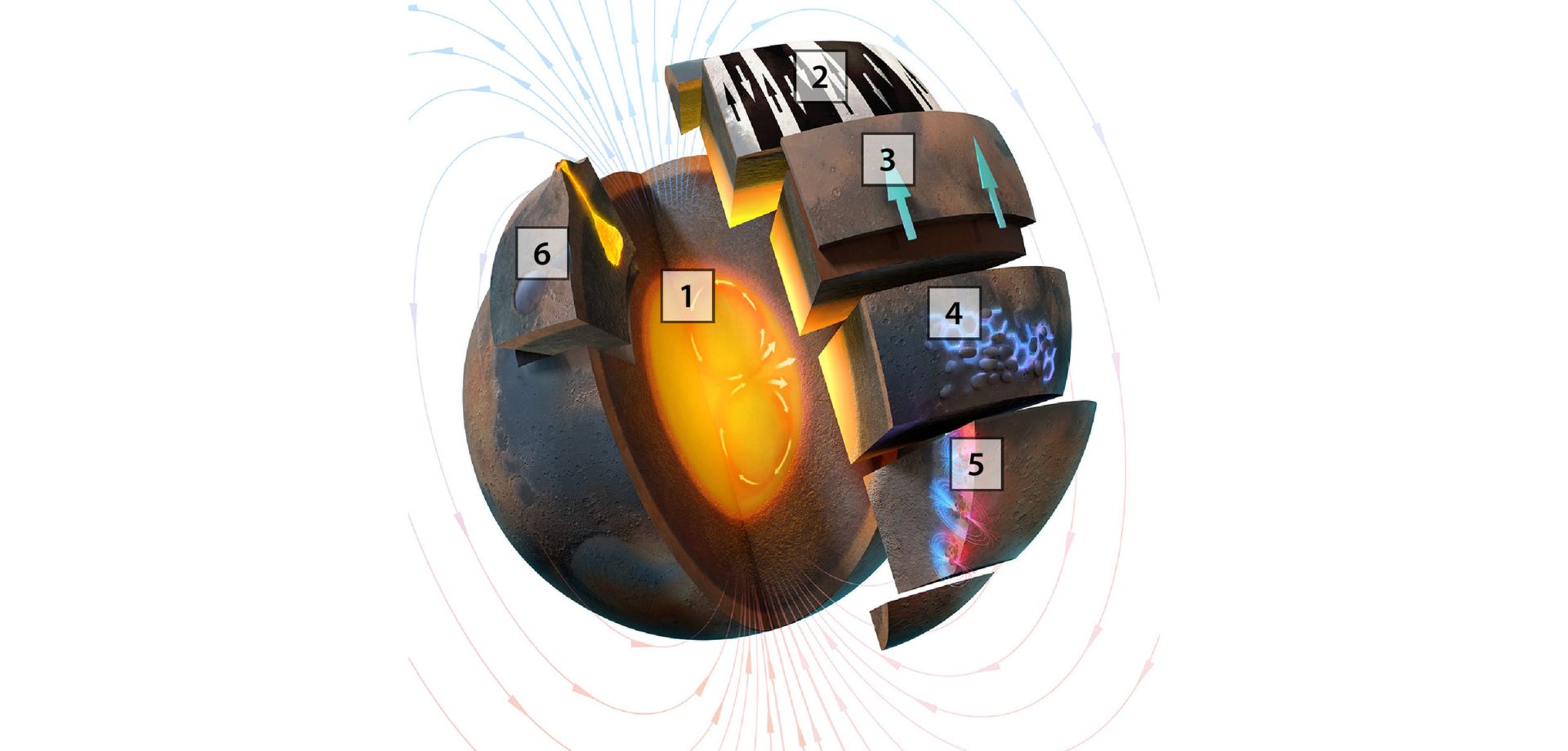
CEREGE - Illustration_article_roches_mars
Fig. 1. Schéma montrant les six objectifs scientifiques relatifs au magnétisme martien. 1. Déterminer l'histoire de l'intensité du champ de dynamo martien. 2. Déterminer l'histoire de la direction du champ de dynamo martien. 3. Tester l'hypothèse selon laquelle Mars a connu une tectonique des plaques ou une dérive des pôles. 4. Déterminer l'histoire de l'altération thermique et aqueuse des échantillons. 5. Identifier les sources de l'aimantation crustale martienne. 6. Caractériser les processus sédimentaires et magmatiques sur Mars.
Reference: B.P. Weiss, E.N. Mansbach, C. Maurel, C.J. Sprain, N.L. Swanson-Hysell, & W. Williams, What we can learn about Mars from the magnetism of returned samples, 2025
Article published February 19, 2025.
Discover also


Share on social media or