


Researchers at the Laboratoire de bioénergétique et ingénierie des protéines (CNRS/AMU) are proposing to exchange and reassemble the subunits that make up the enzymes responsible for oxidation and dihydrogen production, in order to determine what characterizes their catalytic properties. Their results, published in the Journal of the American Chemical Society, will make it possible to manufacture particularly useful new catalytic systems.
Reading time: 3 minutes
|
Things to remember:
|
Enzymes, proteins essential to life
Catalysis is the process of accelerating a chemical reaction using a molecule or material called a catalyst. Enzymes are proteins essential to the living world, acting as catalysts to speed up the chemical reactions necessary for life. They are grouped into families, defined by the structure of their active site*, where the chemical reaction takes place. Each family brings together several "homologous" enzymes, i.e. they have the same active site structure and similar amino acid sequences, but different catalytic properties. They have their own ability to catalyse chemical reactions in either of two directions.
This functional variability also illustrates the existence of long-range effects, arising from structural elements that are distant from the metal ions of the active site. When an enzyme is a complex of several proteins, its catalytic properties may even be influenced by subunits other than the one containing the active site.
Recombining enzyme subunits to determine new properties
To understand these effects, the Marseilles-based researchers took as an example two homologous dimeric hydrogenases, i.e. composed of the assembly of two subunits, one of which contains the catalytic site and the other the so-called "accessory". Both enzymes catalyse the oxidation of dihydrogen, but only one of them also catalyses the reverse reaction to produce hydrogen. The latter is also sensitive to inhibitors (dioxygen and CO) that can interfere with its own ability to catalyse the oxidation or hydrogen-production reaction.
To determine which of the two subunits is responsible for these functional variations, the researchers used protein engineering methods to produce a chimeric enzyme, i.e. an enzyme whose assembly does not occur naturally. To achieve this, they exchanged the different subunits by associating the catalytic subunit of one of the two enzymes with the accessory subunit of the other.
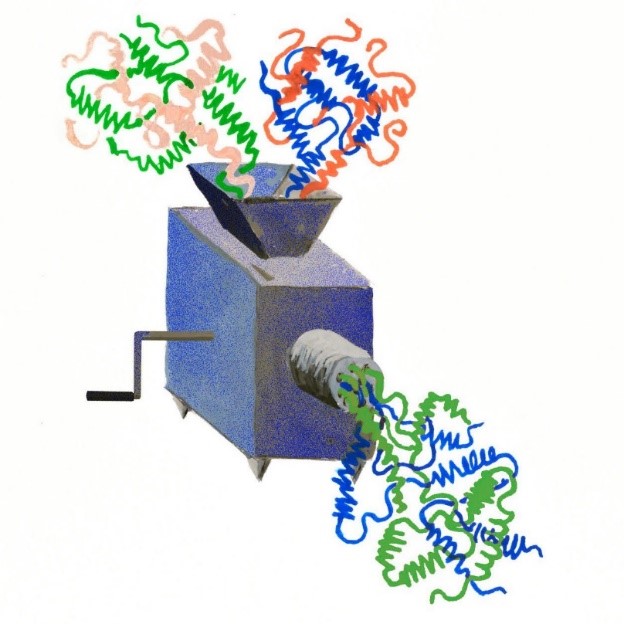
BIP_illustration_Laurent Eisler
Caption: Artistic illustration of the protein engineering method, which involves recombining enzyme subunits to produce a chimeric enzyme.
Credits: Laurent Eisler
This strategy of altering functions by recomposing enzyme subunits provides an insight into the particular catalytic properties of the enzymes studied. These results challenge dogmas about the molecular determinants of catalytic properties in this family of enzymes, and pave the way for the construction of new catalytic systems, which will combine the most desirable properties of distinct homologous enzymes, produced by recombining the subunits that determine these properties.
Contact à ajouter
*Active site: in catalysis, the part of the catalyst that interacts with the substrate(s) to form the product(s).
Illustration credits: Laurent Eisler.
Reference : A. Fasano, C. Guendon, A. Jacq-Bailly, A. Kpebe, J. Wozniak, C. Baffert, M. del Barrio, V. Fourmond, M. Brugna, C. Léger , « A chimeric NiFe hydrogenase heterodimer to assess the role of the electron transfer chain in tuning the enzyme’s catalytic bias and oxygen tolerance », J. Am. Chem. Soc. (2023).
Article published on December 11, 2023.
Discover also


Share on social media or