


An international research team, including researchers from the Marseille Astrophysics Laboratory (LAM, CNRS/Aix Marseille Université) and the Physics of Ionic and Molecular Interactions Laboratory (PIIM, CNRS/Aix Marseille Université) within the Origins Institute, has studied the protosolar nebula, which may have played a key role in the appearance of life in our solar system.
Reading time: 5 minutes
|
Key facts:
|
Protoplanetary disks, structures of gas and dust surrounding young stars, are the sites of planet formation. Understanding the evolution and composition of these disks is essential to elucidating the origin and formation of planets1. The study of the evolution of the composition of the protosolar nebula, the disk at the origin of our solar system, is an active area of research. Recent observations of these disks reveal the presence of complex organic molecules, underlining the importance of these regions for planet formation.
In search of complex organic molecules
Complex organic molecules (COMs), composed of more than six atoms of carbon, oxygen, nitrogen and other elements, are witnesses to a molecular diversity potentially linked to the origin of life. They have been observed in asteroids and comets, where they are considered primordial remnants of the formation of the solar system. Their presence in these objects suggests that they may also exist in the interiors of planets and their moons. The origin of COMs remains a dynamic research topic, with several hypotheses in play. One hypothesis is that these molecules formed in the protosolar nebula from ice grains, under the influence of various physical processes and chemical reactions. In particular, experiments have shown that the irradiation of methanol ice with UV photons, under conditions simulating those of protoplanetary disks (low pressure and low temperature), enables the creation of these complex organic molecules2.
Simulating the protosolar nebula
Using a model simulating the evolution of the protosolar nebula3,4 the team of scientists was able to determine the properties of this disk, including its irradiation by interstellar UV sources. Coupling with a particle transport model enabled us to quantify the average irradiation experienced by a grain of ice in this environment, and then compare these results with the experimental values that led to the formation of complex organic molecules. Simulations, based on different initial conditions and involving 500 particles each, yielded relevant results.
The irradiation dose received by particles in the protoplanetary disk varies according to their size and location. The disk is densest in the zones close to the star and in the median plane. Smaller grains, in the micrometre range, are more vertically mobile and can reach less dense regions, where they receive more radiation.
The emergence of the precursor molecules of life in the solar system
By considering a wide range of sizes and locations, we observe that the smallest particles, farthest from the star, are more strongly irradiated. The study shows that COMs can form from the irradiation of particles from 1 to 100 micrometers, located in regions extending from the location of Jupiter to the periphery of the solar system, over relatively short timescales, from 15 to 350 thousand years. In contrast, larger, centimeter-sized particles do not receive sufficient irradiation in areas closer than Saturn's orbit, requiring nearly a million years to accumulate enough irradiation to form COMs1.
The particular conditions prevailing in protoplanetary disks favor the formation of COMs at different times and in different regions of the disk. UV irradiation of methanol ice covering particles from 1 micrometer to 1 centimeter in size enables the creation of these COMs in the protosolar nebula, from Jupiter's orbit to the outer reaches of the solar system. This process could have played a key role in the emergence of the precursor molecules of life in our solar system1.
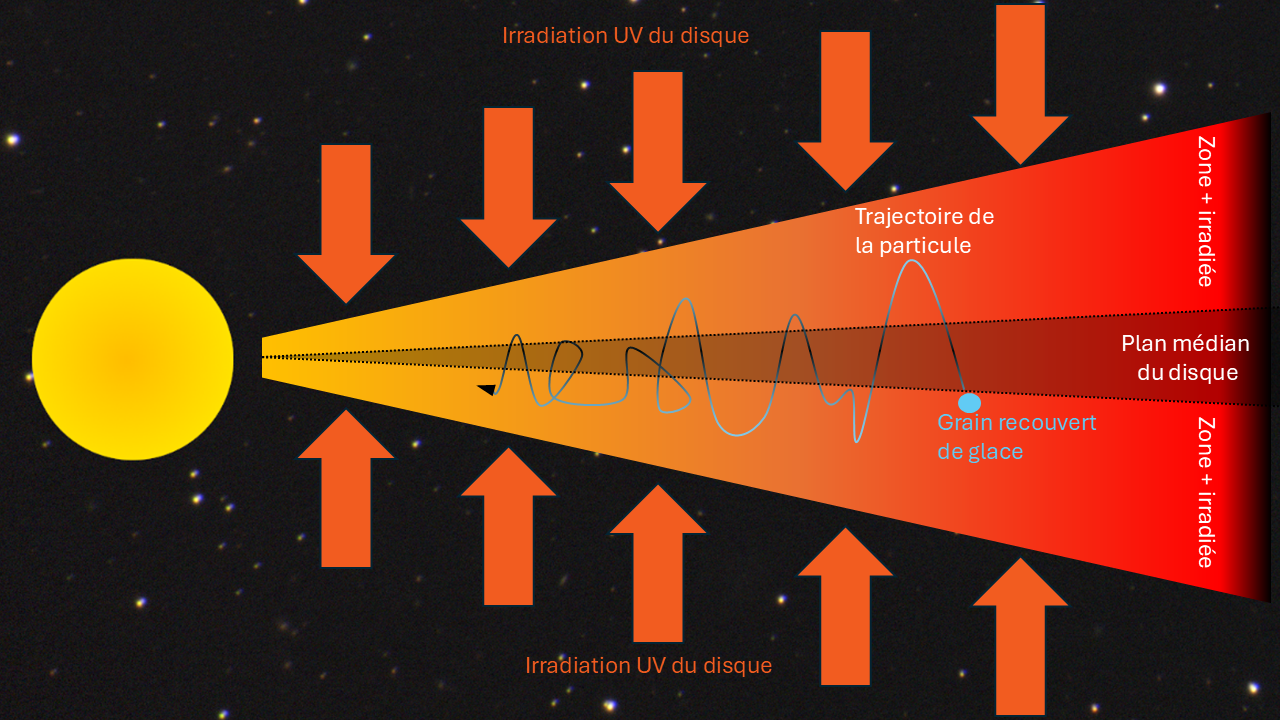
LAM_Illustration_disque_protoplanétaire
Figure 1 : Illustration du transport des particules dans un disque protoplanétaire. L’irradiation interstellaire pénètre perpendiculairement au disque, de sorte que les régions proches de la surface du disque sont les plus irradiées, tandis que le plan médian est totalement opaque aux rayons UV. Les grains se déplacent à la fois radialement et verticalement, ce qui les expose à des conditions d’irradiation variées en fonction de leur trajectoire.
Contact à ajouter
References:
1. Benest Couzinou T. Mousis O., Danger G., Schneeberger A., Aguichine A., Bouquet A., Journey of complex organic molecules: Formation and transport in protoplanetary disks, A&A, November 28, 2024
2. Tenelanda-Osorio L., Bouquet A., Javelle T., Mousis O., Duvernay F., Danger G., Effect of the UV dose on the formation of complex organic molecules in astrophysical ices: irradiation of methanol ices at 20K and 80K, MNRAS 515, 5009 (2022)
3. Aguichine A., Mousis O., Devouard B., Ronnet T., Rocklines as Cradles for Refractory Solids in the Protosolar Nebula, ApJ, 901, 97 (2020)
4. Schneeberger A., Mousis O., Aguichine A., Lunine J.I., Evolution of the reservoirs of volatiles in the protosolar nebula, A&A, 670, A28 (2023
) Photo credit: Judy Schmidt (2017)
Article published Thursday 12 December 2024
Discover also


Share on social media or