

This study was carried out on 28 languages by a group of international scientists (including CNRS researchers). The study showed that up to 98% of participants associated the rolled "R" with a jagged line and the "L" with a smooth line. This is the strongest case ever documented of an iconic correspondence between sounds and meanings. It could represent a breakthrough in the field of linguistics.
Reading time: 4 minutes
|
Key facts:
|
Suppose you're shown two lines, one jagged and the other straight. Which do you think is associated with an "R" sound, and which with an "L" sound? Most likely, you'll associate the jagged line with "R" and the straight line with "L".
Sounds perceived as rough or soft
In fact, in recent research, it was found that a trilled "R" sound (a rolled "R" sound, as in Italian) is systematically associated with rough surfaces while the "L" sound is systematically associated with smooth surfaces, confirming a deep relationship between auditory, visual and tactile perception (Figure 1). The study, published in the Journal of the Acoustical Society of America, involved a series of online and field experiments, for a total of 1030 speakers of 28 different languages, including Zulu, Albanian, Danish, English, Greek, Italian, Farsi, Spanish, Russian, Japanese, Korean, Mandarin Chinese, Thai, Daakie and Palikúr. All these languages have the trilled R sound, with the exception of Palikúr, a language spoken in Amazonia in which this sound is missing. Some of these languages distinguish the trilled R sound (such as Italian or Spanish), while others do not distinguish R/L sounds (as in Japanese or Mandarin Chinese). Participants were presented with images of a jagged line and a straight line, and asked to imagine running their finger along each. Next, participants were made to listen to two sounds, an alveolar trill R and an alveolar approximation L, then matched each sound to one of the lines.
When speech, touch and vision associate
The results show that up to 98% of participants associate the rolled "R" with a jagged line and the "L" with a smooth line, a phenomenon observed even in languages where the R does not exist (Palikur) or in which these sounds are not distinguished. This association is the strongest case ever documented of an iconic correspondence between speech sounds and properties related to our senses of touch and vision. This effect is even stronger than the classic bouba-kiki effect, where people are more likely to call a rounded object "bouba" and a pointed object "kiki".
The researchers suggest that the trilled "R", due to its acoustic properties, establishes a universal connection with 'roughness', irrespective of cultural or linguistic context. These cross-modal correspondences could have influenced the evolution of spoken languages, shaping the words we use to describe texture and form. These results therefore challenge the idea, widely held in linguistics, that in most words there is no connection between the sounds they contain and their meaning.
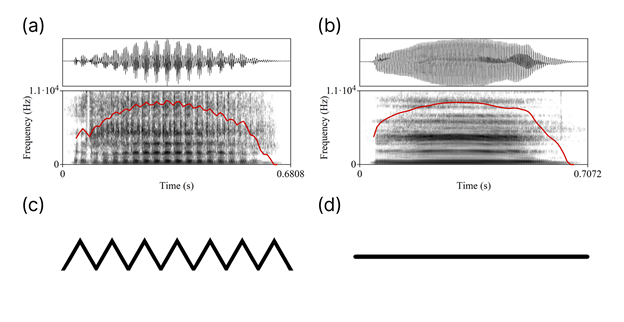
Illustration LPL article
Figure 1. Oscillogrammes et spectrogrammes pour l'enregistrement de (a) le trille alvéolaire [r] et (b) l'approximant latéral alvéolaire [l]. La ligne rouge superposée est la courbe d'intensité avec une plage comprise entre 55 et 85 dB. La ligne irrégulière (c) et la ligne plate (d) étaient les stimuli visuels correspondants présentés aux participants à l’étude.
Contact à ajouter
Contact à ajouter
Reference: Aleksandra Ćwiek, Rémi Anselme, Dan Dediu, Susanne Fuchs, Shigeto Kawahara, Grace E. Oh, Jing Paul, Marcus Perlman, Caterina Petrone, Sabine Reiter, Rachid Ridouane, Jochen Zeller, Bodo Winter. The Alveolar Trill Is Perceived as Jagged/Rough by Speakers of Different Languages. 2024.
Article published on January 20, 2025.
Discover also


Share on social media or