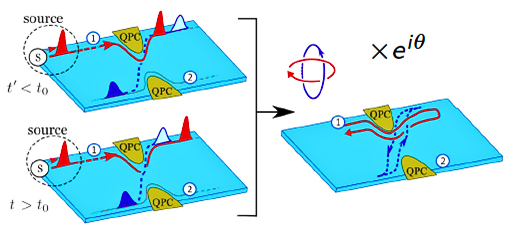


In July 2025, a collaboration between Aix-Marseille's Centre de Physique Théorique (CPT) and ENS Paris reached a milestone in the understanding of quantum matter. By "braiding" exotic particles called anyons, the researchers succeeded in measuring their "scale dimension", confirming a decades-old theory and paving the way for the quantum computer of the future.
Reading time: 4 minutes
|
Key facts:
|
From the semiconductor chip to the mysteries of the two-dimensional world
While quantum physics may sometimes seem abstract, it lies at the heart of our everyday lives. It was quantum physics that led to the understanding of crystals and the invention of the transistor, the basic component of our computers and smartphones. Since the 1950s, science and industry have been working together to manufacture ever-more miniaturized components where electrons can circulate easily.
In the late 1970s, a major breakthrough took place: the creation of two-dimensional electron gases (2DEG). In these ultra-thin systems, electrons now only move in two dimensions, as if on a sheet of paper. It is in this flat universe, subject to temperatures approaching absolute zero and intense magnetic fields, that the quantum Hall effect appears.
Anyons: particles with memory
This 2D world is the scene of some very special phenomena. Electrons come together to form new "excitations" called anyons. Unlike conventional electrons, anyons have fractional electric charge and fractional "statistics".
But what is "statistics" in physics?
- Bosons (like light) like to pile up in the same state.
- Fermions (like electrons) are mutually exclusive.
- Anyons, on the other hand, fall somewhere in between.
Their special feature is braiding. In 3D, if you move one particle around another, nothing changes. But in 2D, the particles keep a trace of this journey: their wave function (their mathematical signature) acquires a complex phase. It's as if the anyons retain a memory of their trajectory around each other.
The anyon "collider": a true experimental challenge
While theory had long predicted these behaviors, measuring them remained an immense challenge. In 2020, teams from ENS Paris and Purdue University had already confirmed the existence of this braiding angle.
In July 2025, the collaboration between CPT and ENS Paris went a step further, publishing a study in the prestigious journal Science. The researchers used an optics-inspired protocol, the Hong-Ou-Mandel experiment, where two photons meet on opposite sides of a semi-transparent mirror.
instead of using conventional mirrors, they use a "quantum point contact" to bring anyons together. By observing how these anyons influence each other as they pass through the mirror (the braiding), the physicists were able to measure the scale dimension of the anyons. This is a crucial mathematical exponent that characterizes their long-term behavior.
Towards tomorrow's quantum computing
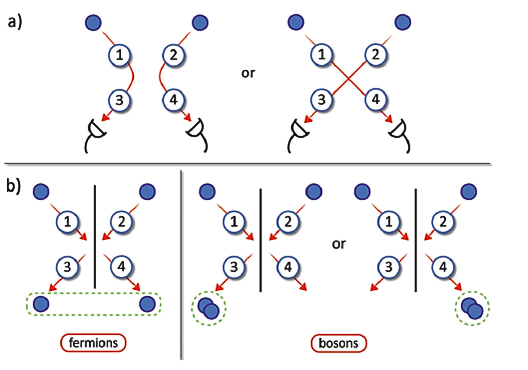
Hong-Ou-Mandel experiment for fermions (the two fermions exit through two different exits. The two bosons, on the other hand, exit through the same exit, because they "like" to be together/in the same state).
This discovery is not just a fundamental feat. The next step is already in sight: the study of non-abelian anyons. These even more complex particles not only change phase when braided, but also perform genuine mathematical (matrix) operations. It is precisely this ability to manipulate information by simply braiding particles that makes anyons the most promising candidates for creating ultra-robust, high-performance quantum computers.
Contact à ajouter
Contact à ajouter
References :
Anyonic Statistics Revealed by the Hong-Ou-Mandel Dip for Fractional Excitations, T. Jonckheere, J. Rech, B. Grémaud, and T. Martin, Phys. Rev. Lett. 130, 186203 (2023)
Time-domain braiding of anyons, Science 389, (2025), M. Ruelle, E. Frigerio, E. Baudin, J.-M. Berroir, B. Plaçais, B. Gremaud, T. Jonckheere, T. Martin, J. Rech, A. Cavanna, U. Gennser, Y. Jin, G. Menard, and G. Feve.
Read the study: link to the article
Article published April 8, 2026.
Discover also


Share on social media or