


Research carried out at the Physique des Interactions Ioniques et Moléculaires laboratory (PIIM, AMU/CNRS) could lead to the development of an innovative platform for quantum computers.
Reading time: 4 minutes
|
Key points to remember:
|
What is a quantum computer?
Whereas a classical computer performs its calculations by manipulating bits, i.e. 0s and 1s, a quantum computer uses qubits: simultaneous superpositions of these two states. Quantum computers could therefore be much faster than classical computers at carrying out certain tasks, but they would need many qubits to do so. However, the higher the number of qubits, the more fragile the superposition of quantum states, which can lead to an early loss of information.
One of the major challenges in the field of quantum computers is the need to keep qubits in a stable state for long enough. Currently, this requires extremely low temperatures, close to absolute zero (-273 degrees Celsius).
A further difficulty lies in the ability to isolate the quantum system, since interaction of the qubits with the environment leads to the loss of their quantum nature (or decoherence), returning them to the state of classic bits.
Making qubits out of Majorana fermions
The paper, co-authored by two researchers from the Physique des Interactions Ioniques et Moléculaires laboratory, opens up the possibility of developing an innovative platform for quantum computers. The silicon nanoribbons of this platform could house Majorana fermions, particles theorized shortly before the Second World War.
These Majorana fermions, or Majoranas, whose specificity is to be both a particle and its own antiparticle (like the qubit, which overlays two simultaneous states), have been sought unsuccessfully for decades in astrophysics. Research then moved on to condensed matter physics, where Majoranas could exist in topological superconductors, enabling the creation of qubits for use in quantum computers.
Indeed, it has been demonstrated that Majorana bound states (MZMs for Majorana Zero Modes) could nestle at the ends of semiconductor nanowires close to a classical superconductor and placed in a magnetic field. This is why such partially aluminum-coated nanowires were created, so that MZMs could be detected by transport measurements at very low temperatures.
The MZMs should have behaved like anyons and not like the usual fermions, enabling the achievement of qubits resistant against decoherence - a major asset for the making of quantum computers. However, hopes were soon dashed, as the inherent defects of the nanowires created this way prevented Majoranas from being achieved.
Theoretical proposal for a new platform
To overcome this problem, the two PIIM researchers proposed the use of a virtually defect-free system: penta-silicene nanoribbons, a massively parallel linear arrangement of silicon pentamers* formed and self-assembled at room temperature.
These nanoribbons, already observed experimentally by various teams around the world, can be detached from their substrate using the tip of a microscope, demonstrating their low interaction with their environment. They could constitute a promising platform for the search for MZMs.
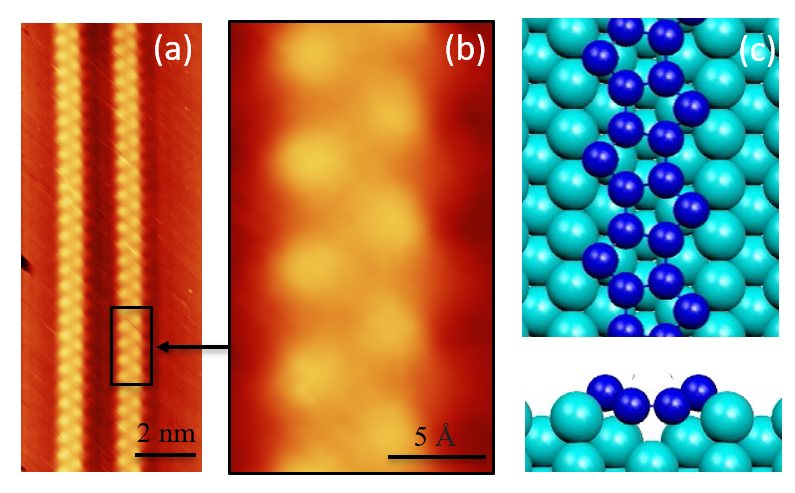
PIIM_Penta-silicene_illustration
Penta-silicene nanoribbons on the surface of a silver crystal, observed by scanning tunneling microscopy.
The two PIIM researchers worked with M. S. Figueira's team at the Universidade Federal Fluminense in Brazil to demonstrate theoretically that these unusual nanostructures, placed under a magnetic field and close to a layer of lead (a non-reactive metal and usual superconductor with a critical temperature of 7.2 Kelvin, or -265.95 degrees Celsius) should host MZMs at their extremities, where they could be detected in situ by tunneling spectroscopy. This way, qubits could be achieved and probably easily manipulated thanks to these very narrow (0.8 nm wide) atomically-thick nanoribbons and their extraordinary lattice, with the aim of developing a new type of quantum computer.
This study opens up the possibility of a new, easy-to-achieve architectonics based on silicon, the material par excellence for microelectronics and conventional computer components. All that remains now is to demonstrate experimentally that all this is really possible - a difficult but exciting task!
Contact à ajouter
Reference: Bento Ribeiro, R.C., ..., Minissale M., Le Lay G. and Figueira M.S. Spin-polarized Majorana zero modes in proximitized superconducting penta-silicene nanoribbons. Sci. Rep. 13, 17965 (2023).
*pentamer: here, a pentagonal arrangement of five silicon atoms.
Article published on January 16th, 2024
Discover also


Share on social media or