


An international team of scientists from Aix Marseille Université, CNRS and the University of Reading (UK) has just published a study, conducted over several years and combining modeling, paleoclimatology and analysis of ecological niches, suggesting that environmental factors were not responsible for the disappearance of the Neanderthals. This study, which analyzed a period of the past (between -90,000 and -50,000 years ago), has a particular resonance today, as it focuses on the relationship between climate change, environmental modification and the survival of a species...
Reading time: 3 minutes
|
Key facts:
|
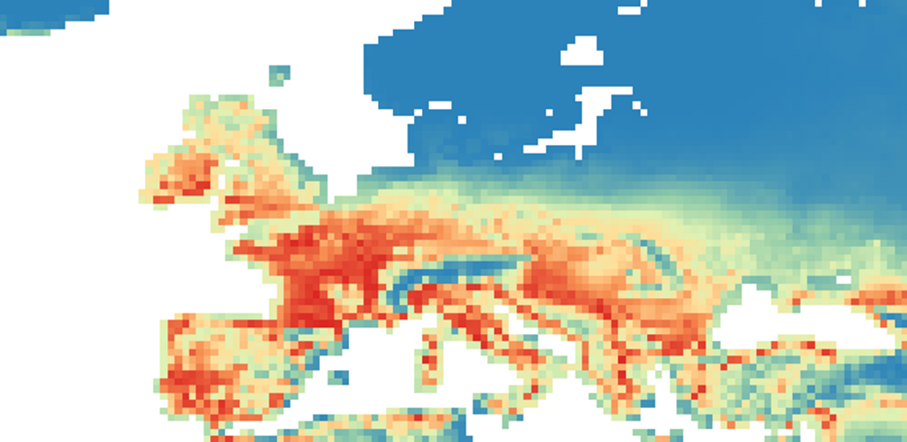
After being the dominant human species in Europe for over 200,000 years, the Neanderthal fossil population disappeared around 40,000 years ago. Competition with Homo sapiens, who arrived in Europe at the same time, is often cited as the reason for this extinction, but other causes could also have been involved. One proposal that is increasingly being suggested concerns the fundamental role of climate change. To test the hypothesis of the effect of climate change, scientists have modelled the evolution over time of ecological niches (i.e. the set of physical-environmental conditions) favourable to Neanderthals in Europe, using paleoenvironmental reconstructions and eco-cultural niche modelling.
LAMPEA - Illustration_Neandertal_1
Figure 1 - Results of the eco-cultural niche modeling software (Maxent1) for the first period studied (between -90,000 and -83,000 years ago): the closer the color is to red, the more favorable the region is for Neanderthals; the closer the color is to blue, the less favorable the region.
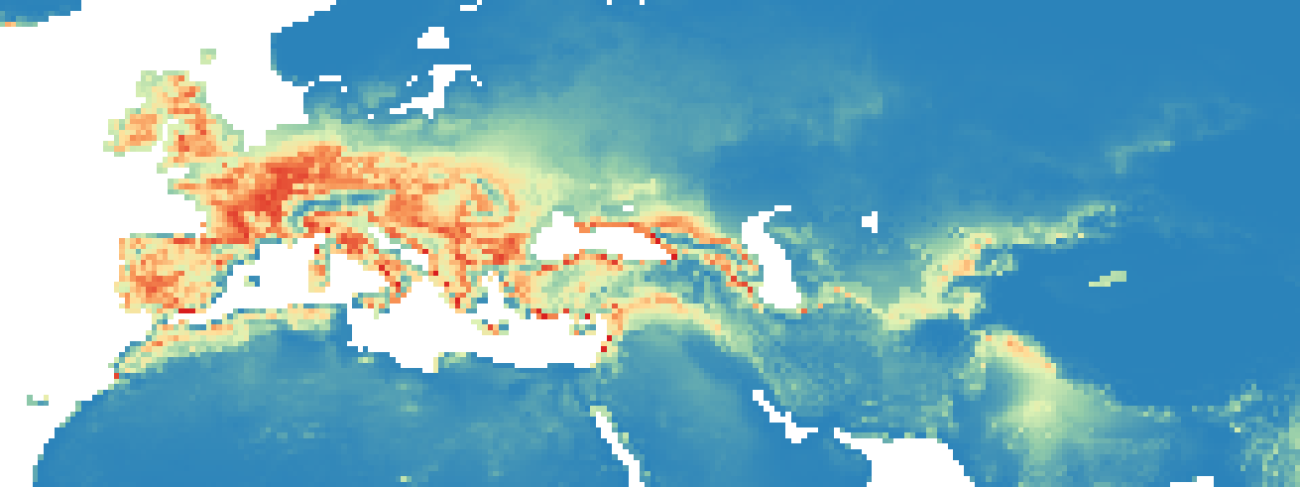
Figure 2 - Results of eco-cultural niche modeling software (Maxent1) for the last period studied (between -51,000 and -50,000 years ago): the closer the color is to red, the more favorable the region is for Neanderthals; the closer the color is to blue, the less favorable the region.
LAMPEA - Illustration_2_Neandertal
Using paleoenvironmental data, they then reconstructed1 the niches favorable to the Neanderthal population over time. Statistical comparisons2 of the evolution of these favorable areas for Neanderthal life over time demonstrate that, after a strong initial environmental change, vast areas highly favorable to Neanderthal occupation persisted during the most recent periods (between -64,000 and -50,000 years ago). The theoretically favorable space available to Neanderthals at the time of their decline has not diminished: the same areas remain favorable over time. In conclusion, the change in the climatic environment of Europe as a whole was probably not the main cause of the disappearance of the fossil Neanderthal population.
This fundamental result3 is part of the still open question as to the causes of the decline or displacement of the Neanderthal population towards southern Europe during prehistoric climatic changes.
Contact à ajouter
Informations complémentaires
Contact à ajouter
Informations complémentaires
References :
- Phillips SJ, Dudík M, Schapire RE. Maxent software for modeling species niches and distributions (Version 3.4.4) [Internet]. 2020. Available from: http://biodiversityinformatics.amnh.org/open_source/maxent
- R Core Team. R: A Language and Environment for Statistical Computing. The R Project for Statistical Computing. 2022. https://www.r-project.org/
- Degioanni A, Cabut S, Condemi S, Smith RS (2025) Climate change in Europe between 90 and 50 kyr BP and Neanderthal territorial habitability. PLOS ONE 20(2): e0308690.
Illustration photo by Silvana Condemi - Neanderthal Museum, Mettmann, Germany
Article published March 4, 2025.
Discover also


Share on social media or