


Researchers from the Anthropologie bio-culturelle, droit, éthique et santé laboratory (Aix-Marseille Université / CNRS / Etablissement français du sang) and the Applied Biomechanics laboratory (IFSTTAR / Aix Marseille Université) have carried out finite-element analyses to digitally simulate australopithecine births and reveal the early origins of the complexity of human birth.
Reading time: 2 minutes
A complex human birth
Birth is not only one of life's most intense experiences, it's also an extremely complex event, part of our evolutionary history and closely linked to biological and cultural phenomena. Human childbirth is all the more remarkable for the specific features that distinguish it from that of other primates. The difficulty of human childbirth is not found in other great apes, and rarely in other primates. At the end of this complex delivery, human mothers give birth to a newborn considered "immature", given its neurological characteristics, explained in particular by the size of its skull, which is very small compared to its future adult size.
In the course of human evolution, the birth of newborns with small skulls seems to respond to an obvious imperative: that of being able to pass unhindered through the complex shape of the maternal pelvis. This necessity seems to be linked to the acquisition of bipedalism, which restructured the architecture of the birth canal. To test this hypothesis, the study of australopithecines is ideal, as these hominins were already bipedal, but still had rather small brains in adulthood. For this fossil group, it is therefore possible to study the influence of bipedalism alone, on the proportion of neonatal cranial size to adult size.
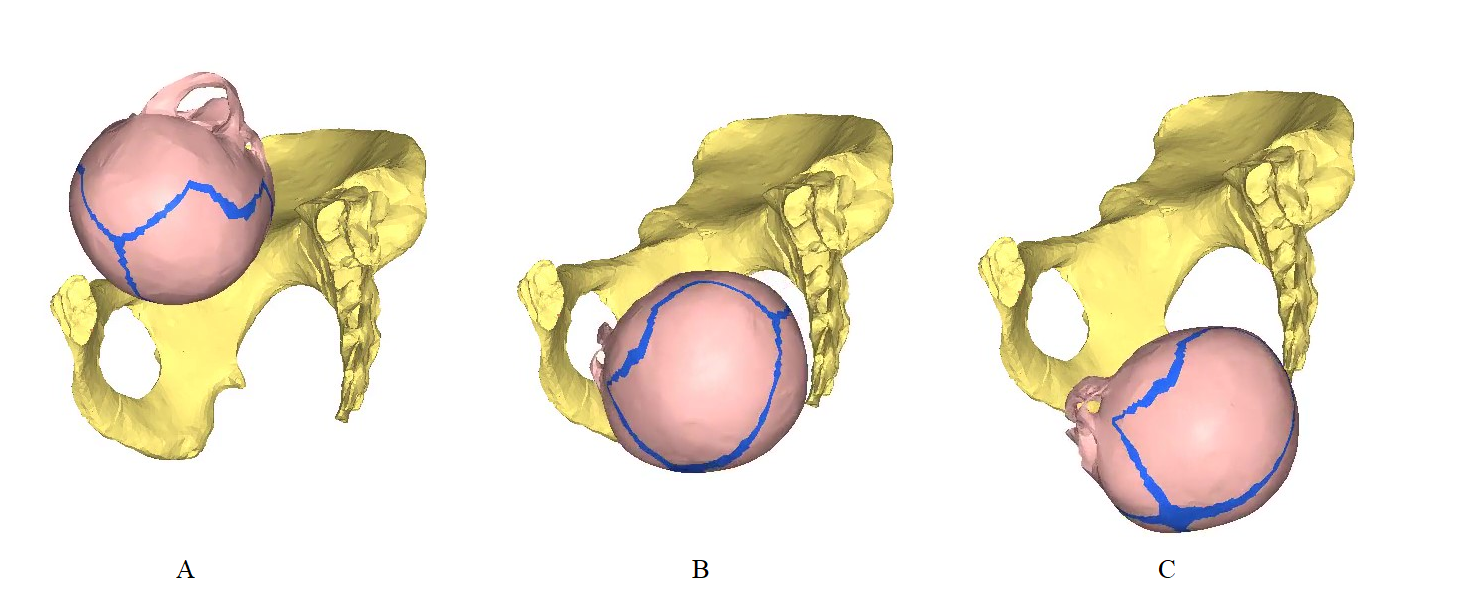
The different stages of Lucy's delivery with a small-skulled fetus (110g) modeled by finite-element analysis: A engagement, B descent, C clearance. - Credit: © Pierre Frémondière
Digital simulation of australopithecine births
Following finite element analyses carried out by the researchers, in order to digitally simulate australopithecine births with different ranges of neonatal cranial size, it turns out that australopithecines must have had, like modern humans, a rather low proportion between neonatal and adult cranial size. This suggests that cooperation in the care of infants within the group would have appeared early in human evolution, implying elaborate social functions. Bipedalism therefore seems to be the starting point for the acquisition of these new higher cognitive skills.
Contact à ajouter
Published on April 19, 2022 in Communications Biology.
Reference : Frémondière, P., Thollon, L., Marchal, F. et al. Dynamic finite-element simulations reveal early origin of complex human birth pattern. Commun Biol5, 377 (2022).
Discover also


Share on social media or