


A new planet around the star Gl410, located 40 light-years from our Sun in the constellation Leo, has been discovered by an international team led by researchers from the Laboratoire d'Astrophysique de Marseille (amU/CNRS/CNES), the Institut de Recherche en Astrophysique et Planétologie de Toulouse, the Institut de Planétologie et d'Astrophysique de Grenoble and the Université de Montréal. This discovery1 was made using the SPIRou spectropolarimeter, installed on the Canada-France-Hawaï telescope at the summit of the Maunakea volcano, and the SOPHIE spectrograph at the Observatoire de Haute Provence (CNRS/amU).
Reading time: 5 minutes
|
Key facts:
|
The neighborhood of our solar system is dominated by small, cool stars, called red dwarfs. Their low luminosity makes it difficult to detect exoplanets orbiting these small stars. They also tend to have planets of more modest mass, making them harder to detect. These low-mass planets, close to and orbiting red dwarfs, are exciting, as they are the first for which it will be possible to explore the composition of their atmospheres.
One or more new planets discovered
Through repeated observations over several years, the light from the star Gl410 has spoken: velocity measurements have revealed a periodic motion that is due to the presence of a planet ten times the mass of the Earth, orbiting its star in six days.
Based on the series of measurements, scientists then carry out statistical tests that reveal the degree of confidence they have in these discoveries. The detection of exoplanet Gl 410 b is considered certain. Two other planets could be present with orbital periods of 3 and 18,7 days respectively, which would make the Gl 410 system a compact, resonant set of low-mass planets. Further measurements are required to confirm these two additional planets.
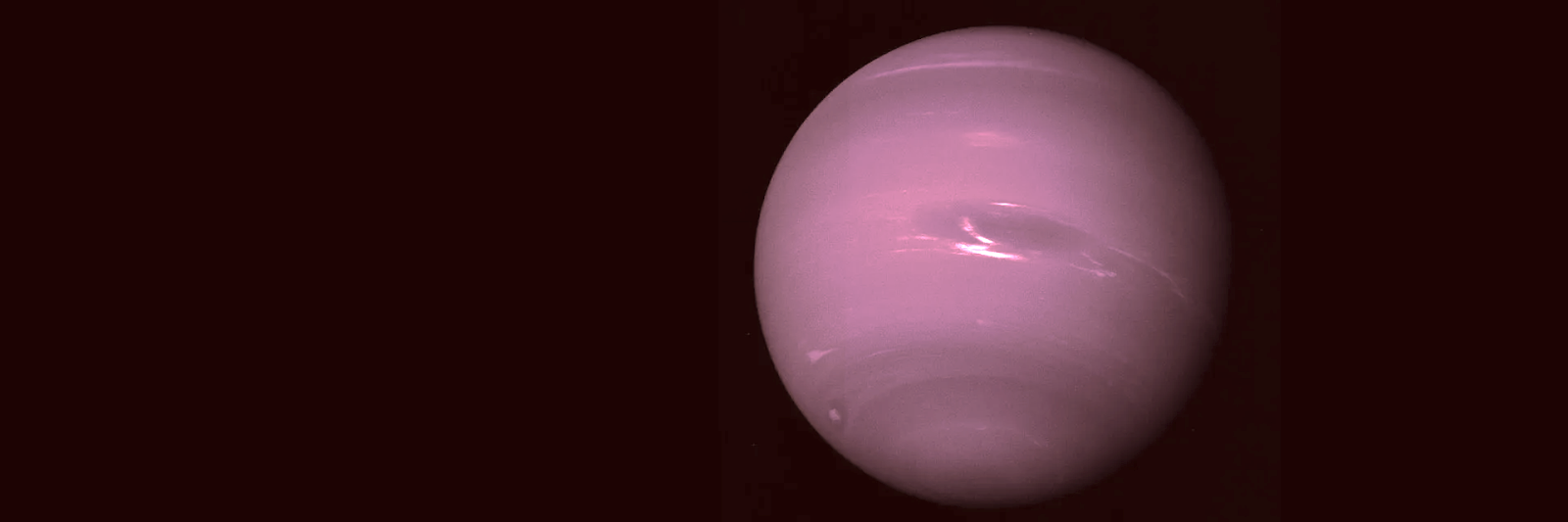
Vue d'artiste
What do we know about this planet?
Gl410's orbital period is six days, so it receives 20 times more heat from its star than the Earth does from the Sun, and its equilibrium temperature2 could be around 300°C. The planet could be like Neptune, but much hotter!
Scientists also know that this planet must be subject to strong and frequent eruptions from its star: red dwarfs are known to have a very active magnetic field. Gl 410, half as massive as the Sun, is a relatively young star (500 million years), and SPIRou measurements confirm a magnetic field 100 times more intense than that of our Sun.
The discovery of planets around stars as active and eruptive as Gl 410 is crucial for understanding the evolution of planets. These planets were very difficult to detect as long as stellar velocity measurements were only made optically, with stellar activity clouding the measurement. SPIRou works in the infrared, providing a new, more stable observation window, and it is the combination of its measurements with those of SOPHIE that makes this difficult detection possible.
The discovery of exoplanets is an intense team effort, deployed from the design of an instrument to its operation and the advanced analysis of its data. These discoveries were also made possible by the incomparable quality of the sky at the summit of Maunakea volcano, where the Canada-France-Hawaii telescope is installed, equipped with the SPIRou instrument, and at the Observatoire de Haute-Provence, from where the SOPHIE spectrograph observes.
Observations were carried out as part of the SPIRou Legacy Survey, a Franco-Canadian program totalling over 300 nights over 3 years. They were combined with SOPHIE observations obtained mainly between 2021 and 2023 from a very large program conducted on SOPHIE for over 10 years.
About the combined use of SPIRou and SOPHIE
SPIRou, a spectrograph operating in the infrared spectral range from the Canada-France-Hawaï Telescope, is more sensitive to starlight than ordinary optical instruments. It is at once a high-resolution spectral ladder spectrograph, a high-precision velocimeter and a spectropolarimeter operating at infrared wavelengths. These features make it the ideal instrument for observing red dwarfs and simultaneously studying their planetary suites and the properties of their magnetic fields.
These features make it the ideal instrument for observing red dwarfs and simultaneously studying their planetary suites and the properties of their magnetic fields. SOPHIE is the high-resolution spectrograph installed on the 193cm telescope at the Observatoire de Haute-Provence. It has been operating in the visible range with m/s precision for over 10 years. By observing the same star with the SOPHIE spectrograph installed on the 193cm telescope at the Observatoire de Haute Provence, scientists can distinguish the signature of a planet (which will be the same seen with both spectrographs) from an effect due solely to the star (which will give a signal that varies from one instrument to another).
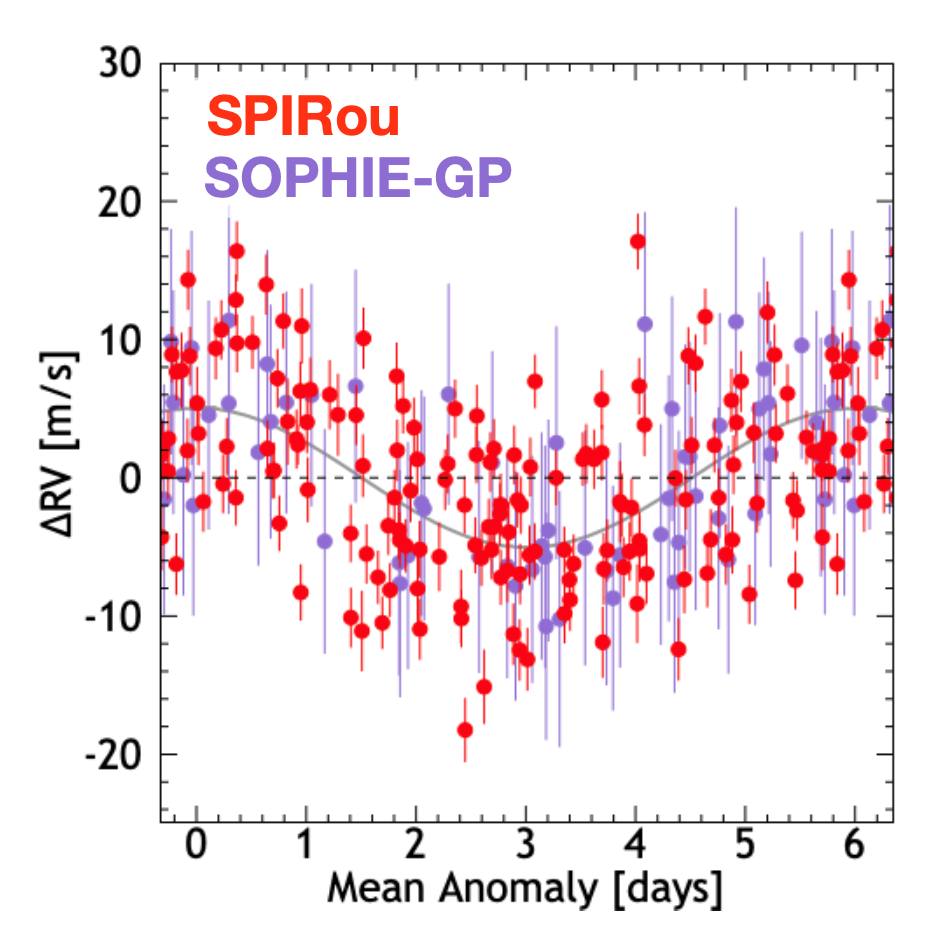
Gl410's radial velocity variation as seen by the SOPHIE (visible light) and SPIRou (infrared light) spectrographs, indicating the planet's presence at 6 days orbital period.
Gl410's radial velocity variation as seen by the SOPHIE (visible light) and SPIRou (infrared light) spectrographs, indicating the planet's presence at 6 days orbital period. The dispersion around the expected curve (in grey) could be due to the presence of one or two additional planets in the system.
Contact à ajouter
- Carmona, A. et al. "Characterizing planetary systems with SPIRou: Detection of a sub-Neptune in a 6 day period orbit around the M dwarf Gl 410." (2025).
- The equilibrium temperature of a planet depends solely on the heat source of its star. The presence or absence of an atmosphere is not considered.
Article published Tuesday April 15, 2025.
Photo credit: Nathalie Desmons
Discover also


Share on social media or