


What do a ream of paper, desert dunes, muscle fibers and the endoplasmic reticulum of cells have in common? Seen as a whole, these so-called smectic structures are organized on a large scale in locally parallel layers. They are also active, as they are subject to local energy injection via exposure to a mechanical (wind in the case of dunes) or chemical (ATP hydrolysis in cells) environment. In a work published in the European Physical Journal Special Topics (EPJ-ST), theorists from Aix Marseille Université, the Max Planck Institute (Dresden) and the Institut Curie (Paris) develop a generic theory that describes the temporal evolution of active smectics.
Reading time: 4 minutes
|
Key facts:
|
Active smectic systems can exhibit perpetual flow - in contrast to previously well-studied passive materials. Scientists predict that in the presence of dislocations - breakpoints in the layers - an abrupt transition occurs at a critical value of the amount of energy injected, taking the system from a static state to a permanent turbulent flow. This work is part of a special edition in memory of Étienne Guyon, a pioneer in liquid crystal dynamics and turbulence.
A ream of sheets of paper: a smectic system
Take a ream of sheets of paper, with one sheet protruding halfway up one side. The inner edge of the sheet represents a local defect in a previously regular arrangement: this is known as dislocation. Now, pull the sheet a little further towards the outside of the ream: it will pull the others, causing them to slide over each other. This situation is typical of a very generic class of sheet materials, which we call smectic, in reference to soaps (smēktikos in ancient Greek), the first materials in which this type of lamellar organization was discovered.
In the work Lin et al. published in EPJ Special Topics, in honor of Étienne Guyon, the physicists develop a theoretical framework for predicting the relative dynamics of smectic materials. In particular, they predict where and when breaks occur, how they propagate, and manage to express these dynamics in terms of local mechanical forces.
When a dislocation moves, it drags along the fluid and surrounding layers. The authors show that this triggers instability: the layers bend spontaneously and the associated flow becomes chaotic.
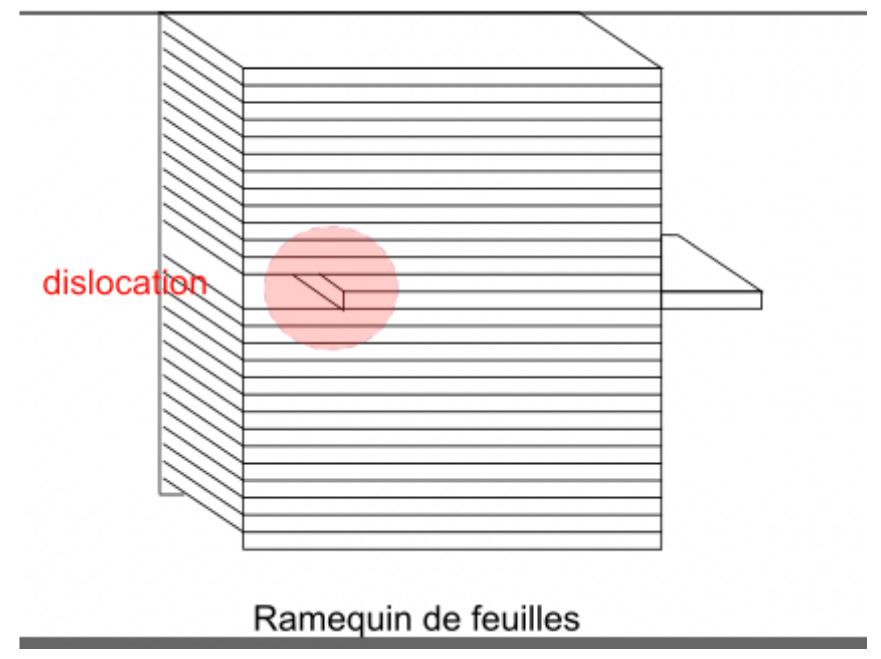
Representation of a dislocation within a smectic system: a sheet is extracted from a ream of paper.
Aix-Marseille University (AMU) follows CNIL guidelines
The platform that broadcasts this content conditions its reading to the deposit of tracers in order to offer you targeted advertising according to your navigation.
By clicking on 'I authorize', the cookies will be deposited and you will be able to view this content.
I authorize
From the movement of dunes and muscle fibers ... to brush strokes
This generic framework offers potential applications for a wide class of natural or biological structures. Among them, the dynamics of sand deserts (dunes, seen from above, form layered patterns and ridge lines with dislocations), muscle fibers, or even the endoplasmic reticulum.
The authors also envisage an application with an artistic dimension. In the film The Van Gogh Passion (Loving Vincent), Vincent Van Gogh's paintings come to life, characterized by a structure of regularly spaced lines and continuity of brushstrokes. The Lin et al. work provides a physical dynamic for these lines, and a realistic animation of Van Gogh's paintings.
Contact à ajouter
References :
- Lin, Julicher, Prost and Rupprecht, EPJ Special Topics, special issue in honor of Étienne Guyon, (1935-2023) physicist, specialist in superconductivity and hydrodynamics, professor at ESPCI ParisTech and honorary director of the École normale supérieure. https://link.springer.com/article/10.1140/epjs/s11734-025-01904-5
- Voir article in the same issue by José Eduardo Wesfreid on Étienne Guyon - https://link.springer.com/article/10.1140/epjs/s11734-025-01906-3
Article published October 1, 2025.
Discover also


Share on social media or