


Each of our steps happens naturally, without us even paying attention. And with good reason: like the cephalophoric saints, or Rodin's "Walking Man", it is the spinal cord, rather than the brain, that orchestrates our locomotion. Research conducted at the Institut de Neurosciences de la Timone (AMU/CNRS) by Dr Frédéric Brocard's team has revealed the central role played by Nav1.1 and Nav1.6 sodium channels in the automation of walking. This scientific breakthrough, published in "Cell Reports", sheds new light on the mechanisms underlying our locomotion.
Reading time: 4 minutes
|
Key points to remember:
|
Central pattern generators, the key to locomotion
There is a network of neurons located in the spinal cord, called central pattern generator, which is responsible for our locomotion. These neurons, with their non-linear properties, shape and adapt our motor control to the environment or to our needs. Thanks to these properties, the interneurons, those located between two neurons, oscillate autonomously to initiate and regulate our walking rhythm. Similarly, motor neurons, which transmit motor commands to muscles, exhibit a non-linear behaviour known as bistable, which enables them to maintain prolonged activity following brief stimulation, thereby regulating the duration of muscle contraction. At the heart of this dynamic is the "persistent sodium current" or INAP. Although essential for its non-linear properties, little is known about the ion channels responsible for this current.
Nav1.6 and Nav1.1: sodium channels essential for movement
To identify them in mice, the scientists developed various genetic, immunohistochemical, electrophysiological and behavioural approaches. The Nav1.6 sodium channel was found to be a major player in INAP in motor neurons. It is mainly located at the beginning of the motor axon, responsible for nerve distribution in muscles. Without it, the non-linear properties of motor neurons fail, leading to limb paresis, i.e. partial or mild paralysis, manifested by a reduction in muscle strength. This makes it difficult for the animal to move. This observation highlights the close link between muscle tone, the Nav1.6 channel and the bistable electrical properties of motor neurons.
The INAP of interneurons differs from that of motor neurons. It does not depend exclusively on the Nav1.6 sodium channel, but also on Nav1.1. Its co-expression with Nav1.6 has been confirmed by immunohistochemistry*. The absence of these two channels paralyses the spinal cord and prevents it from generating a locomotor rhythm, illustrating the vital importance of these channels in our ability to move.
A better understanding of certain motor deficits
This study sheds further light on the neurophysiological mechanisms regulating locomotion. Although apparently natural and automatic, walking is the result of a complex molecular and neuronal symphony in which the Nav1.1 and Nav1.6 sodium channels play a major role. This scientific breakthrough could provide a better understanding of the cause of certain motor deficits and pave the way for new therapies aimed at reducing them.
INT_Brocard_schema_locomotion
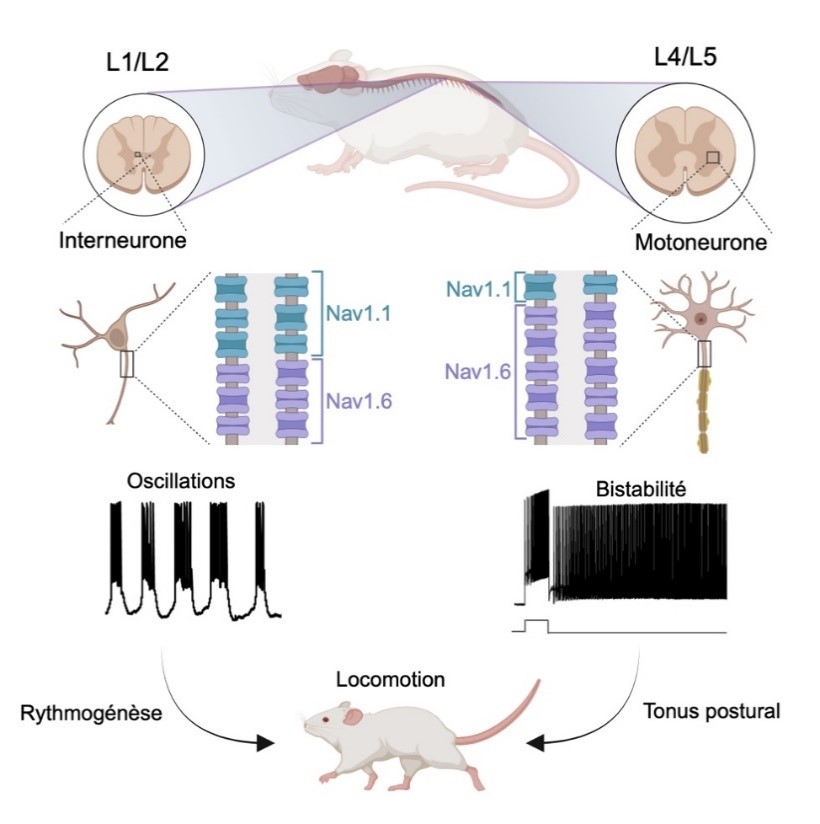
This diagram shows a mouse spine, zoomed in on an interneuron (located in the L1/L2 vertebrae) and a motoneuron (located in the L4/L5 vertebrae). We then see the specific distribution of Nav1.1 (blue) and Nav1.6 (purple) sodium channels, on these two types of neuron.
In the interneuron (left), Nav1.1 and Nav1.6 channels are present in equal quantities. This configuration enables the interneurons to produce regular oscillations (shown in the diagram), essential for controlling and regulating gait rhythm in mice.
In the motor neurons (shown on the right), the Nav1.6 channel is more abundant. This predominance of Nav1.6 channels plays a key role in the interaction of motoneurons with muscles, facilitating their sustained contraction. This action helps to maintain the muscle tone required for movement and stability of the mouse's body as it moves.
Using the diagram to understand: This diagram illustrates the location of interneurons and motor neurons in the spinal cord of a mouse. It shows the specific distribution of Nav1.1 (blue) and Nav1.6 (purple) sodium channels on these two types of neuron.
In the interneuron, Nav1.1 and Nav1.6 channels are present in equal quantities. This configuration enables the interneurons to produce regular oscillations, essential for controlling and regulating the gait rhythm in mice.
In the motor neurons, the Nav1.6 channel is more abundant. This predominance of Nav1.6 channels plays a key role in the interaction of motor neurons with muscles, facilitating their sustained contraction. This action helps to maintain the muscle tone necessary for the movement and stability of the mouse's body as it moves.
*immunohistochemistry: a technique for detecting proteins in tissue using purified antibodies specific to the protein of interest. The antibodies are made detectable by combining them with a fluorochrome, a peroxidase or electron-dense molecules for electron microscopy.
Reference: Persistent Nav1.1 and Nav1.6 currents drive spinal locomotor functions through nonlinear dynamics. Drouillas B, Brocard C, Zanella S, Bos R and Brocard F. Cell Reports. 2023.
Article published December 4, 2023.
Discover also


Share on social media or