


The BoneApp digital osteology database was developed at the Mediterranean House of Human and Social Science (MMSH) as a free and intuitive tool dedicated to promoting osteological collections. Its mission is to highlight the heritage of partner institutions by facilitating access to their specimens through digitization. Currently, the catalog is based on the physical collection of LAMPEA, housed at the MMSH, which was mainly assembled by J.-P. Brugal (Emeritus Research Director at the CNRS, LAMPEA) during his career.
Reading time: 3 minutes
The Mediterranean Laboratory of European and African Prehistory (LAMPEA, amU/CNRS/INRAP), in collaboration with the MMSH and the National 3D Data Repository, has developed a free 3D osteotheca accessible to all.
Currently showcasing the laboratory’s collections, this tool aims to facilitate learning and research by offering 3D models enriched with annotations and descriptive content. This tool will evolve to incorporate other osteological collections and can be adapted to other 3D digitization projects.
BoneApp is designed to address the gaps inherent in the distribution and completeness of osteological collections across the country by digitizing and sharing these collections for educational and scientific purposes. Its publication was guided by the FAIR principles of open science and the recommendations of the 3D SHS Consortium.
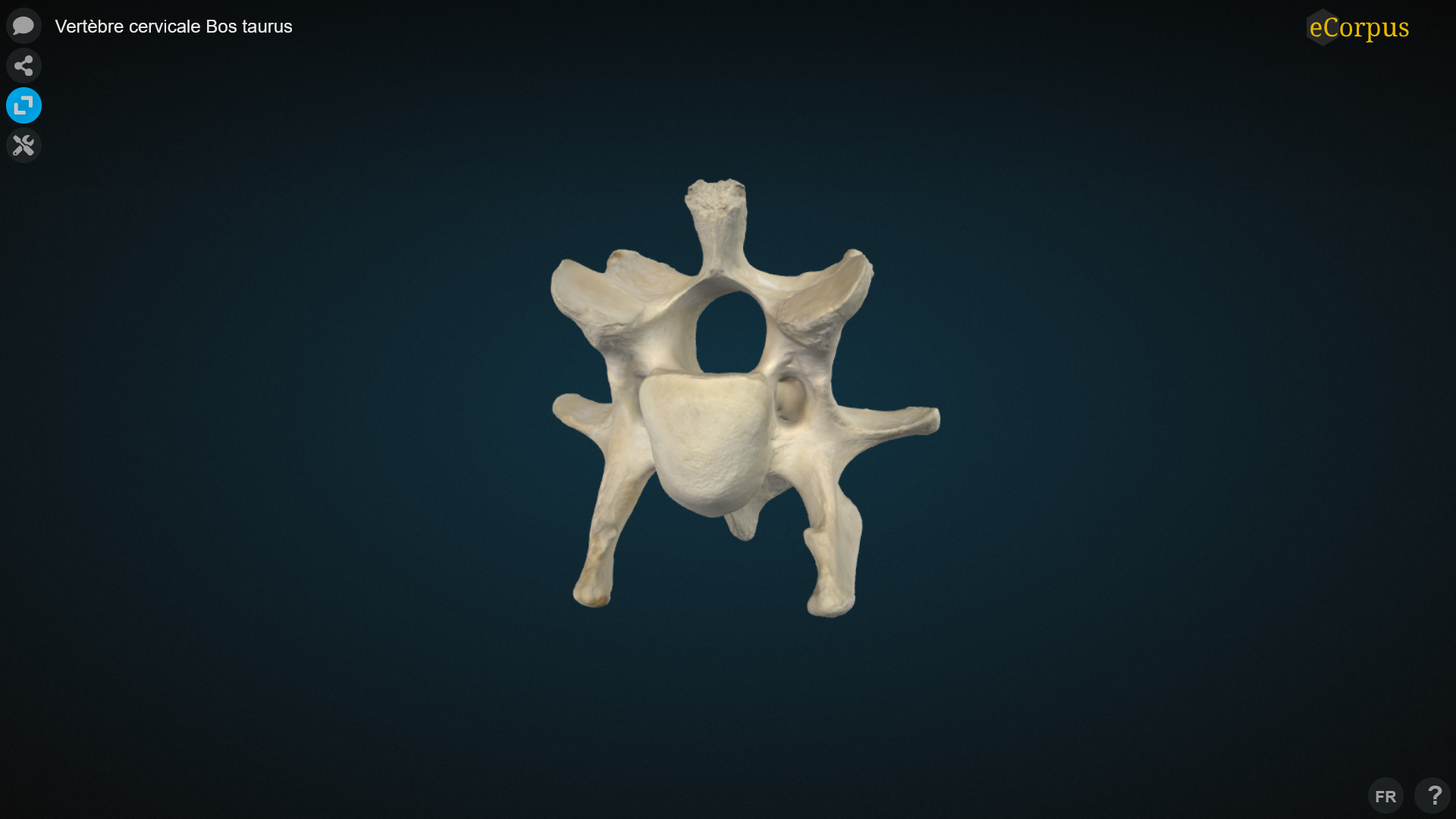
Among other information, BoneApp provides access to an accurate 3D representation of the bones available in the catalog
BoneApp
The goal of this virtual catalog is to provide at least one complete reference specimen for each taxon of large mammals that inhabited Europe during the Pleistocene and Holocene. In doing so, LAMPEA provides a robust comparative tool for researchers working on archaeological and paleontological contexts.
Learning anatomical criteria in paleontology and archaeozoology relies on extensive practice in comparative anatomy and access to diverse bone collections. Although specialized atlases and publications exist, they are sometimes outdated and do not always provide consistent or sufficiently comprehensive terminology. Furthermore, access to osteothecas is uneven due to their scattered locations, a lack of coordination between institutions, and the heterogeneity of the collections, which complicates the work of students and researchers.
In response to these challenges, digital platforms offering 3D models of vertebrates have been developed, providing a variety of educational tools. However, these solutions are often incomplete: they vary in usability, sometimes use proprietary formats, and do not always allow for data reuse or interoperability.
With BoneApp, LAMPEA provides the scientific community, students, and the general public with a sustainable, scalable, and open tool that promotes the dissemination, sharing, and reuse of osteological data. By facilitating access to digitized reference collections, this 3D osteology library helps to revitalize teaching, research, and the promotion of scientific heritage in accordance with the principles of open science.
To explore the app, visit https://boneapp.mmsh.fr/osteoapp/
The BoneApp team: the scientific team comprises Thibaut Guiragossian (IR AMU-Amidex/LAMPEA), Pierre Magniez (MCF AMU/LAMPEA) and Stéphane Renault (IR CNRS/LAMPEA). The development and maintenance of the database and website infrastructure are carried out by Simon Moré (IE CNRS/MMSH), Romain Suarez (IE AMU/MMSH) and Vincent Bayle (IR CNRS/MMSH).
Acknowledgements: the BoneApp developers would like to thank everyone who contributed to the project, in particular Tamara Glushetckaia, Thibault Guillaumont, Sarah Tournon, Medhi Chayani and Loïc Damelet. They would also like to thank the LAMPEA students who helped drive this project forward and without whom it would not have been possible.
Discover also


Share on social media or