


Increasing soil sealing has numerous consequences, not only for the water cycle, but also for quality of life. Alain Sandoz, a researcher in landscape planning, explains why the project to remove waterproofing from university campuses is essential.
Reading time: 3 minutes
Fanny Trifilieff: What's the point of depaving?
Alain Sandoz: The Saint-Charles and Saint-Jérôme sites are highly urbanized and concreted. The lack of permeable soil, especially on the Saint-Charles site, and of green spaces, prevents rainwater infiltration, which is therefore evacuated via the combined sewer system and thus into the sewers. During periods of heavy rainfall, there is a risk of saturation of the networks, as well as flooding downstream of the sites. Reducing soil permeability would enable better management of rainwater, which could then infiltrate directly into the ground and into the water table. It could also bring two types of benefits to the campuses, improving the living environment: the development of biodiversity thanks to the increase in vegetated surfaces, and the creation of cool islands by reducing surface albedo*, by reducing the number of coated surfaces, by the shading provided by plants and also by the evapotranspiration** of these plants, which also helps to reduce surface temperature.
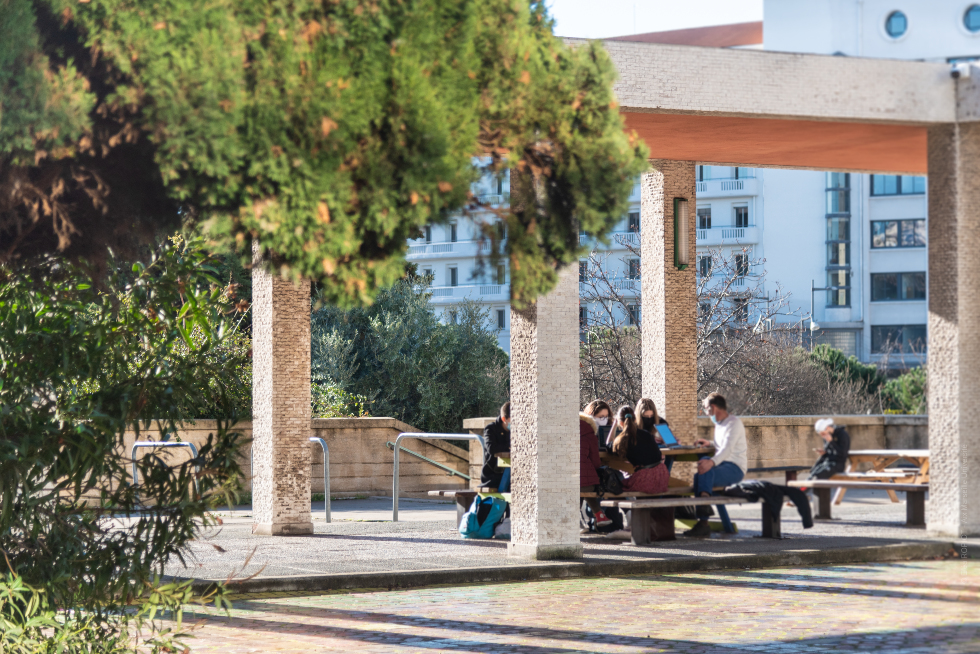
Saint Charles Campus - Credit: Eléa Ropiot - Aix-Marseille Université
F.T: What role does the university community play in this project?
A.S: Launched from January 2021 to June 2022, this feasibility study is receiving 187,000 euros in funding from the Agence de l'Eau Rhône Méditerranée Corse as part of its "Rebound Plan". This is a multi-disciplinary applied research study with an educational component, the aim of which is to propose specific developments and draw up scientific monitoring protocols. The study will also quantify the expected gains in terms of water infiltration, biodiversity, freshness and quality of life. The university community is heavily involved, with lecturers, teachers, administrators and students all taking part. The study brings together a team of researchers in hydrogeology, plant and animal biology, urban biodiversity, chemistry, sociology, geography... as well as design engineers and landscape architects. Students are also involved, particularly those studying for a professional degree in landscape planning.
F.T: What are your future prospects?
A.S: Saint-Charles and Saint-Jérôme are pilot sites. The development of specific solutions in the Mediterranean environment will enable similar projects to be developed in other urban and peri-urban areas in the future. If implemented following this feasibility study, it will be an emblematic operation for the region's ecological transition. The research carried out will make it possible to propose solutions based on the skills and know-how developed as part of the project and transferable to a public of working professionals, particularly in local authorities. Ultimately, a university diploma could be created to train current and future developers. Initial results are expected by the end of 2021.
Contact à ajouter
*Albedo: fraction of solar radiation reflected by a given surface.
**Evapotranspiration: Quantity of water evaporated by the soil and plant transpiration.
Interview originally published in the June 2021 Lettre d'AMU.
Discover also


Share on social media or