

Associate Professor at Aix-Marseille Université and researcher at the Centre de Physique Théorique, it is not her research in theoretical physics that Adeline Crépieux has come to talk about in this interview. For years, she has been working on another research project: bringing women scientists from the past and their discoveries out of the shadows.
Reading time: 7 minutes
Fanny Trifilieff: could you introduce yourself?
Adeline Crépieux: I am an associate professor at the Science Faculty of Aix-Marseille Université for around twenty years. I am affiliated to the Centre de Physique Théorique where I work on the modeling of electronic transport in nanoscale systems.
F.T: How did you come up with the idea of writing this book?
A.C: The idea took root slowly. It's a subject I've been interested in for over ten years. It all started with an observation I made during my studies and then my professional life: when you study theorems or formulae, you come across the names of scientists which, most of the time, refer to men. In my discipline, physics, but also in mathematics, women researchers are still in the minority. My work was based on the idea that there must have been women who had contributed to the various fields of science throughout history. When I looked into the matter, I found a number of women's names, some of which have been attributed to theorems such as Noether's (editor’s note: Emmy Noether) or Cauchy-Kowalevski's (Augustin Cauchy and Sofia Kovalevskaya).
Gradually, I collected the names of these women scientists, mainly mathematicians and physicists at first, but then I broadened my research. I started by listing my finds on a website, and then the idea emerged of putting them together in a book to tell the story of their lives. My interest was strengthened by the fact that when I consulted dictionaries of physicists and mathematicians, women were virtually absent. In particular, I realised that some women who had made great discoveries were not even mentioned. And yet, they very often had a reason to be there. This book illustrates my determination to honour women scientists whose work has been overlooked.
F.T: How do you go about finding information about women whose work has been overlooked throughout history?
A.C : I think the fact that I'm a researcher helped me get started on this major project. I researched everything I could, in particular through history books written in French and English (which are much more extensive on this issue). There are also a number of academic articles about certain women scientists. I had to find them and work through them. For some figures, there is a lot of documentation available, so it was more a case of extracting information from the mass of references. For others, it's more complicated, because there are few documents and a lot has been lost. In this case, it's more complex, so I've contacted historians. You always have to check and cross-check information, because what you can find, especially on the Internet, is sometimes wrong. It's been a lot of hard work.
F.T: How did you choose the 110 women in the dictionary?
A.C: Over the years, I've collected many more names than the 110 that made it in the book. I easily had twice as many. I focused on six scientific disciplines: physics, maths, computing, chemistry, biology, and astronomy. Obviously, there are many other personalities to highlight in medicine, palaeontology, botany and so on. But I had to make choices to avoid spreading myself too thinly. Then, the choice itself was guided by the publisher, who advised me to limit myself to women who died before 1950. The reason for this? The closer you get to the present day, the harder it is to say which research will go down in history. All the same, I negotiated to include all the women who had won a Nobel Prize or a Fields Medal.
F.T: Did you have any particular ambition when you wrote this book?
A.C: Initially, not at all. It may sound selfish, but if I worked on this issue, it was above all because it interested me personally. When I made a website about it, it was a way of bringing these portraits together and getting an overview. I started to think that it would be interesting to share, and that was confirmed by the fact that the site was extremely popular. Written entirely in English, it was particularly popular in English-speaking countries, especially schools in the United States. I wasn't expecting this level of interest, but it reflects a real need to find out more about these little-known personalities.

Cover of "Petit dictionnaire illustré des femmes scientifiques: 110 noms, d'Hypatie aux récentes nobélisées" by Adeline Crépieux, published by Ellipses
There is no recent version of a dictionary of women scientists. When I saw how many people visited the site, I got the idea of writing this dictionary. I found a publisher who agreed to publish me, and it took me two years to write the manuscript. As I was writing the entries for each woman, I realised that most of these women had to overcome enormous difficulties in order to train and work. Universities have only been accessible to women very recently in history. As I wrote and researched, I discovered that in different countries, even if universities were not open to women, there were public schools, or not, that were set up to enable some of them to train. I was totally unaware of this, and it seems important to talk about it and pass it on to current and future generations.
F.T.: Finally, is there a woman whose story or work has made a particularly strong impression on you?
A.C: That's a difficult question, because every time I wrote a description of a woman, she became my favourite at the time. Searching for information is laborious, but when you come to write the entry, that's the fun part of the project. It's very difficult to choose because they all have something specific. But I'm going to try and give some names anyway!
I'm particularly fond of women mathematicians because I think it's admirable what they managed to do with the limited educational resources they had, particularly Sofia Kovalevskaya, whom I mentioned earlier. I'm also very fond of Sophie Germain, a French mathematician born in 1776. She was born at a time when women were not allowed to study at university, and her family did not initially want her to study mathematics. Except that maths was all she was interested in. So she managed to get the courses from students at the Ecole Polytechnique and taught herself. She then assumed the identity of a Polytechnique student to correspond with mathematicians. In particular, she wrote to Carl Friedrich Gauss pretending to be a man. It was only later that Gauss learned that he was corresponding not with a man, but with a female mathematician, and he was all the more impressed. Sophie Germain's main work concerned elastic surfaces, for which she won the Grand Prix de Sciences Mathématiques from the Académie des Sciences in 1815. She was also interested in Fermat's theorem, a mathematical theorem that was unsolved at that time, on which she made advances.
Finally, in the wider scheme of things, I find that when it comes to women scientists, Marie Curie always comes to mind, but in fact that's almost a shame, because it hides so many other women who have made incredible discoveries.
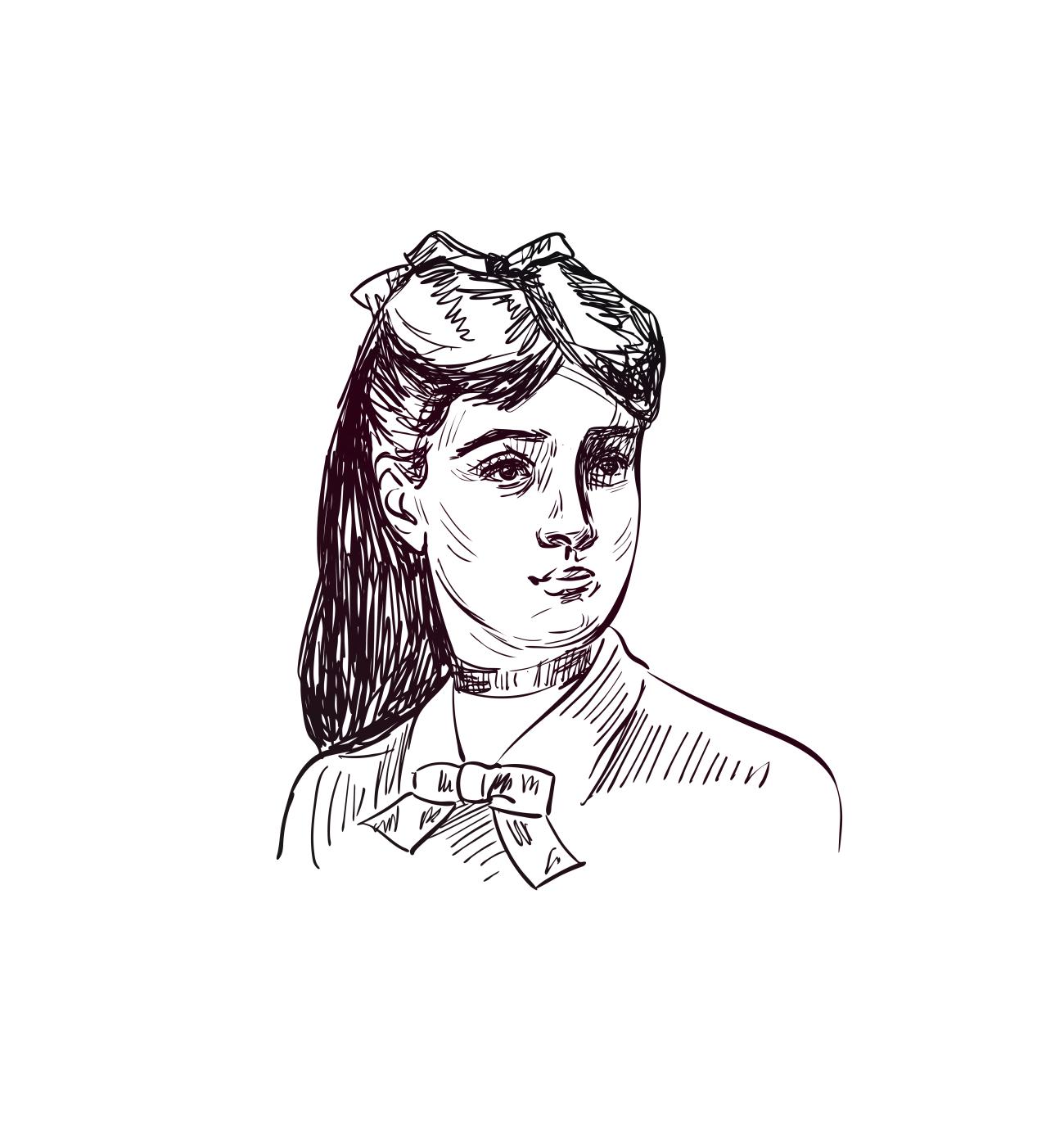
Drawing of Sophie Germain, mathematician.
The "Petit dictionnaire illustré des femmes scientifiques - 110 noms, d'Hypatie aux récentes nobélisées" by Adeline Crépieux has been available at Ellipses publishing since June 2023.
The book has been endorsed by the CNRS as part of the Year of Physics 2023-2024.
Contact à ajouter
Informations complémentaires
Article published December 8, 2023.
Header photo credit: ThisisEngineerig RAEng on Unsplash
Book cover credit: Ellipses publishing
Sketch of Sophie Germain credit: Shutterstock / Natata
Discover also


Share on social media or